Romanticism has been ridiculed for its reductive, idealised notions of the world and some bygone past. Yet a healthy dose of Romantic-Realist dreaming can be revolutionary, honouring our emotions rather than suppressing them, and allowing us to imagine and work towards a better world.
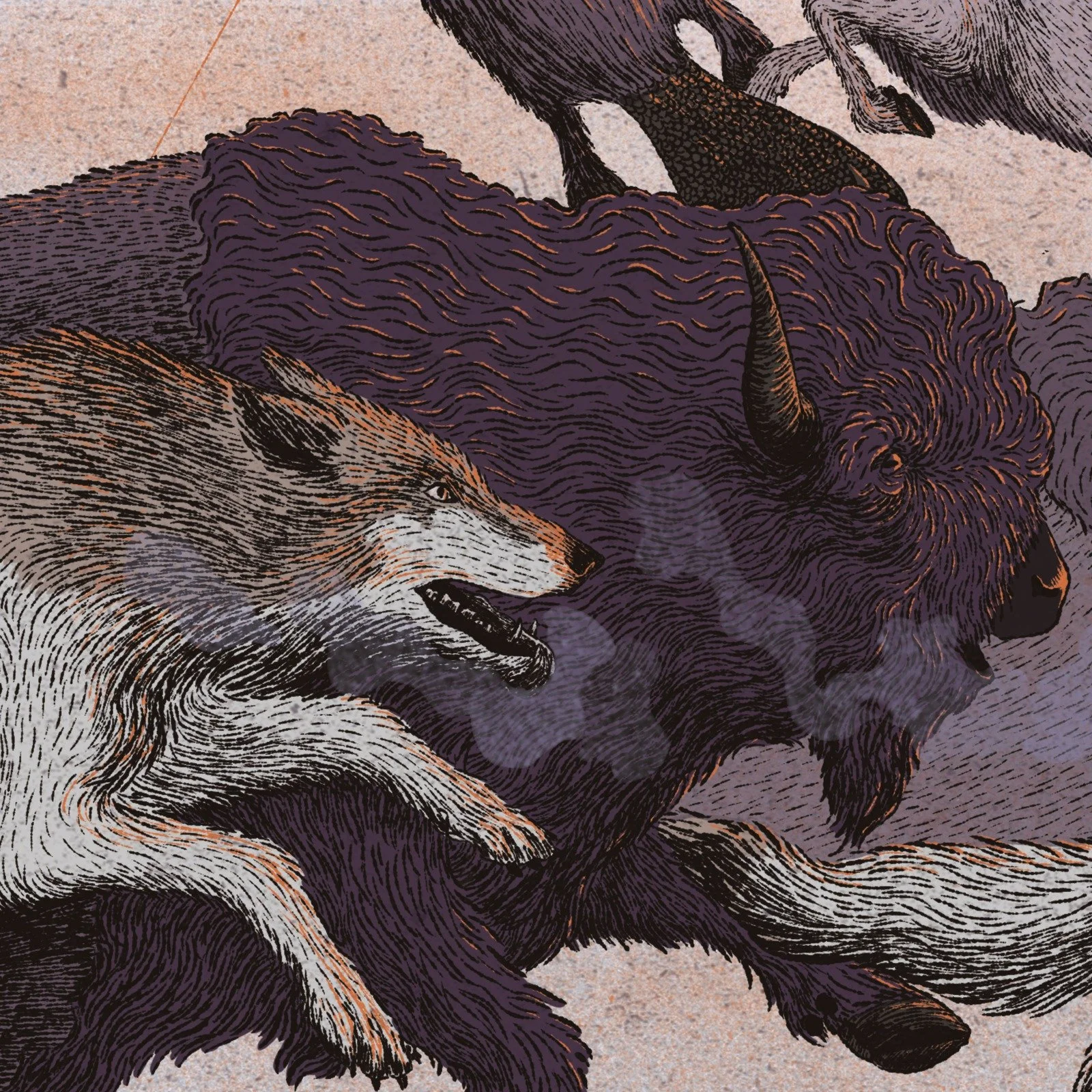
Illustration © Kaitlynn Copithorne
It is oft repeated that Gustave Flaubert hated Romanticism because real life never measured up to it. That is, in essence, the through-line in his novel Madame Bovary. Emma Bovary’s provincial marriage to an ordinary man doesn’t live up to her romantic notions for life, which she learnt from novels.
The books she read promised exotic travel, adventure, and passionate, all-consuming love. But modernity has blighted these dreams. She finds herself in a modern cage. Everything is predictable and mundane, including her husband, Charles, ordinary and flawed.
Flaubert’s portrayal of the French countryside is bleak – it’s flat, predictable and marked by ennui. There are no commons to escape to – no wild places. It’s quite the anti-bucolic vision. Madame Bovary’s only salvation is to be found amidst purchasable distractions – “She wanted to die but she also wanted to live in Paris.” – and in great gestures and passionate love affairs which enable her to project onto nature whatever she is feeling.
“Madame Bovary, c’est moi”, said Flaubert, but he might as well have said that she is every one of us, dissatisfied as we are with modernity. There is this sense, for most of us, of a bigger life happening somewhere beyond us, and we are unable to fully participate.
Flaubert is remembered as a fervent critic of Romanticism. The problem was that Flaubert remained a Romantic and was frequently, in spite of himself, moved. Madame Bovary can be read as self-satire.
Flaubert was not against Romanticism per se, but against a bourgeois conception of it, concerned with nostalgia for some imagined past, grand gestures and luxurious commodities. He satirises Emma’s attempt to escape the drudgery of provincial life by participating in the ready-made fantasy of the bourgeois elite instead of cultivating something deeper, finding the extraordinary in the ordinary. If we hate Emma Bovary it’s because we, like Flaubert, see ourselves in her; her grievances are symptomatic of living within this broken system.
Now well into the so-called age of modernity, many of us have as a relationship with Romanticism as complicated as Flaubert’s.
On the one hand, I worry that some attempts to escape capitalism today are as individualistic as Emma Bovary’s. Many of us seek relief in the exotic and novel; we seem to only be able to enjoy nature as a marketable experience. We still buy into the elitist brand of Romanticism Flaubert railed against.
We see this individualistic Romanticism reproduced on social media platforms like Instagram and TikTok where users are rewarded for leaning into romantic aesthetics – “romanticising my life”. The reality, meanwhile, is that they are unpaid content producers, filming reels instead of making the ordinary truly extraordinary. It is this type of Romanticism, where fulfilment can be acquired by those with the means, which still reigns supreme in our collective imagination; a sort of historic cosplaying concerned above all with self-image, like trad wives, and the elitist appropriation/fetishisation of working class folk culture.
On the other hand, Romanticism has become conflated in our minds with something defanged and cloyingly sweet – even manipulatively so; films or books that dilute real experience and promise us tears – fake, then.
Today books are praised for being “not romantic” and “unsentimental.” As we are realising in the age of AI, cultural institutions are rewarding writers for their lack of meaning, and for reflexively writing about all things visceral and disgusting (because presumably, this is the only safe, secular thing in our hyper-normal modern lives that makes us feel something, without really making us feeling anything?).
Our simplistic aversion to Romanticism makes us stupid, because we are feeling creatures who pretend we are not, and this is so often used against us. We decry sentiment but cannot see how our own perception is filtered through feeling.
Werner Herzog has vocally rallied against the “Disneyfication” of wild nature. In his documentary Grizzly Man, he tells the story of Timothy Treadwell, an environmentalist and bear enthusiast who spent thirteen summers living among bears in Alaska with no guns, bear spray or any recommended precautions. On his thirteenth summer, he and his girlfriend got mauled to death by a bear.
At the end of the film, Herzog declares,
“And what haunts me, is that in all the faces of all the bears that Treadwell ever filmed, I discover no kinship, no understanding, no mercy. I see only the overwhelming indifference of nature. To me, there is no such thing as a secret world of the bears. And this blank stare speaks only of a half-bored interest in food. But for Timothy Treadwell, this bear was a friend, a savior.”
In case it is not clear enough, elsewhere in the narrative, he articulates his ideology more clearly, “I believe the common denominator of the universe is not harmony, but chaos, hostility, and murder.”
Are bears indifferent? To each other, probably not – though someone will dismiss every act of care as instinct. But how do they feel about other species? Very rarely bears attack humans, but we’re far, far more likely to be killed by another human than mauled by a bear – and we’re far more likely to kill a bear than to be killed by one. There are also numerous examples of bears forming relationships with humans, either because they were raised by them, through habitation or because they lived besides a human culture that fosters respectful co-existence.
Interspecies altruism is hard to empirically measure, because we are unable to ask other animals about their motivations, but there is research supporting altruism in humpback whales, who defend other marine animals, such as seals and sunfish, from orca attacks.
Current scientific consensus is that the human conscience evolved to enable us to survive together – and most of us acknowledge some feeling for other animals, even if we have cultural myths that help bypass these feelings. It would appear that the conscience exists in other animals too, including rats who in experiments refuse food if it means a fellow rat will come to harm. Am I projecting too? Perhaps, but also perhaps not.
To assume indifference is often part of the worldview of those who preach “I believe in science”, but it isn’t particularly scientific. As the late primatologist Frans de Waal put it, “The key point is that anthropomorphism is not always as problematic as people think. To rail against it for the sake of scientific objectivity often hides a pre-Darwinian mindset, one uncomfortable with the notion of humans as animals.”
In an open letter, naturalist Charles Russell, known for his research among grizzly bears, praised Herzog as a “skilled filmmaker” but criticised his portrayal of Treadwell as “a nut case with a death-wish. His commentary expounds his own, very simple ideas about nature and how man doesn’t belong out there in wild nature with all these horrible animals.” Russell wished that Treadwell had followed bear safety advice, but worried that Herzog’s narrative would sway public opinion in favour of bear culls. “The fact that Timothy spent an incredible 35,000 hours, spanning 13 years, living with the bears in Katmai National Park, without any previous mishap, escapes people completely.”
A problem among Romanticism’s most vocal critics is they don’t engage with the roots of our aversion to the movement. They will, like Herzog, dismiss any attempts to project feelings onto nature because they have bought into the capitalist notion that to do so is foolish. Herzog doesn’t seem to understand that he too has absorbed an ideology, one based on violence, the one that powered the industrial revolution, that enables AI, the same sentiment which fuelled Ahab’s vengeance against the whale Moby-Dick, in Herman Melville’s magnum opus.
“All visible objects, man, are but as pasteboard masks,” says Ahab. He hates the “inscrutable” thing which lies behind the whale. He too sees chaos and hostility. But that, like the instinctual, mechanical “indifference” Herzog sees in bears, is his own projection.
And what a bleak, unhelpful projection it is. The opposite of Romanticism can be just as damaging as unanchored Romanticism, offering us little more than a destructive, self-focused prism through which to view the world.
Those who conflate feeling with foolishness, who infantilise it, have fallen hard for the propaganda of the modern era, which ridiculed magic and sentiment. What’s more, feeling is often culturally gendered as feminine, and suspect towards it often veils misogyny and a capitalist mindset concerned with aesthetics and little else.
Feeling isn’t irrational though, nor something we should infantilise; it is essential, also as a form of rebellion against the institutions and corporations who tells us what to feel. One could say that all the things we love are born from feeling and while memories of the specifics fade, feeling is the one thing that will endure.
One of Herzog’s contemporary literary heroes, Cormac McCarthy, had a very different view of nature from Herzog’s. The post-apocalyptic world he presents in The Road is bleak and violent, but the man and his son are resisting its violence, mourning, like the Romantics before them, the “old” world:
“It took two days to cross that ashen scabland. The road beyond fell away on every side. It’s snowing, the boy said. He looked at the sky. A single gray flake sifting down. He caught it in his hand and watched it expire there like the last host of christendom.”
Theirs is not thoughtless nostalgia but a yearning for a world which means something – and a commitment to carry its fire. At the end of this love letter to his son, the narrator enjoys a final soliloquy:
“Once there were brook trout in the streams in the mountains. You could see them standing in the amber current where the white edges of their fins wimpled softly in the flow. They smelled of moss in your hand. Polished and muscular and torsional. On their backs were vermiculate patterns that were maps of the world in its becoming. Maps and mazes. Of a thing which could not be put back. Not be made right again. In the deep glens where they lived all things were older than man and they hummed of mystery.”
Of course, we readers know these things are still there (but for how long?). McCarthy reminds his son, and by turn us, that we can tread another path, approaching the unknown not with violence or indifference – both stemming from disavowed feeling; radically, he gives us permission to be moved by it.
The resolution of Madame Bovary is that we should put aside a bourgeois conception of a life well-lived, but we can still strive to make the world a better place. This thinking is the seed that sowed my narrative non-fiction, debut, The Book of Beasts: Reclaiming Animal Wisdom. Of all the stories we could have told about the world, why have we opted to tell the most boring and violent ones? Where everything is devoid of inherent meaning and real life must be purchased? Where nature is indifferent?
Tracing stories from around the world, from the past and present, I found alternatives to the ones in dominant cultures, where we’re more likely to run into simulacra than real animals. Stories that express a more real and meaningful otherworld which lies beneath the Baudrillardian veneer of modern life, a world where our lives and the lives of other animals have meaning, where we can foster different relationships with that “inscrutable” thing which lies behind the masks of other animals, a world which we can collectively invoke wherever we are.
The Book of Beasts: Reclaiming Animal Wisdom will be published by Chatto & Windus on 6th August, 2026.

This essay appeared first on our Substack, The Cunning.