There’s a whale on the cover of our forthcoming issue so let’s speak about how to unmake a monster. For centuries, whales were regarded as sea monsters and associated with devilry and deception. How did we come to reappraise them, and why do they elicit our sympathy in ways so many other animals do not?
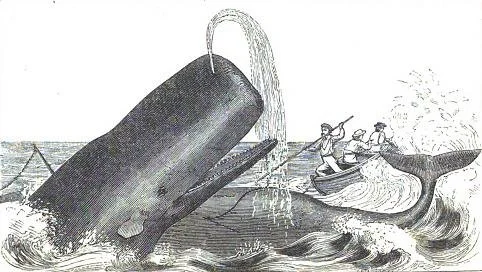
From Etchings of a Whaling Cruise by J. Ross Browne
In the sixth century AD, a large whale was reputed for sinking ships in the waters off the Constantinople. For over fifty years, he terrified seafarers who navigated the inland Sea of Marmara. Fear was tinged with admiration. The Byzantines called him Porphyrios – possibly owing to the purplish tint to his skin (deriving his name from Imperial purple, porphúra in ancient Greek) or after contemporary celebrity charioteer of the same name, or the mythological giant Porphyrion who fought against the Olympian gods.
Emperor Justinian sought to capture and kill this whale – a near impossible feat. Yet one day the great whale chased dolphins close to shore. He swallowed some of them whole while others fled, but still he pursued the rest, “either still impelled by hunger or by a contentious spirit”, as 6th-century Roman historian Procopius puts it in History of Wars VII, and beached himself near the mouth of the Sakarya River. Local people came out with their axes, hacking away at the whale’s flesh but failing to kill him. Then they cut him into pieces – some devoured the meat on the spot.
Porphyrios was perhaps a large sperm whale, like Moby-Dick, or a large orca. Ancient people, like most of us, would only catch a glimpse of these colossal barnacled creatures who rise, island-like, from the great deep and then return there. There was the worry such creatures might drag us down with them.
The very word ‘cetacean’ – referring to mammals such as whales who have made the sea their home – stems from the Ancient Greek ‘Kêtos’ and its Latin derivative Cetus. Cetus referred to colossal sea monsters, often depicted on mosaics and vases as dragon-like or serpentine creatures, sometimes horned. Cetus were often beasts to slay; heroes such as Perseus and Heracles slew Cetus to save fair maidens. Elsewhere, ancient perceptions of Cetus seemed more ambivalent: nereids, oft benevolent sea nymphs, are frequently depicted riding these large sea creatures. The Cetus is often not bad in itself, but instrumentalised as a form of divine punishment, sent by Poseidon to wreak havoc on those who defied the will of the gods.
Whales as monsters; whales as vengeful gods. It is this latter image which typifies the Hebrew story of Jonah and the Whale. When Jonah sails away from his divine duty, he is swallowed by a large fish, often understood as a whale. After three days inside the whale, Jonah repents and commits to obey God’s orders. The whale is not antithetical to God but part of God’s kingdom.
Fish or mammal. Saviour or devil? Watching the distant tails and dorsals fins of whales rising from the surf, it’s easy to see why people have misconstrued what whales are. Most of us never see them. Those of who do only catch glimpses. Coast dwellers are more likely to see a beached whale than a live one. From these fragments we make monsters or gods or embodiments of nature’s indifference from our own projections.
It should be stressed that classical chroniclers knew a fair bit about whale, even when the artists who portrayed them always missed the mark. Aristotle observed whales on the Aegean Sea, conversed with seafarers about cetacean behaviour and dissected whales. In his History of Animals, Aristotle notes that whales do not have gills, but blowholes which allow them to breathe, and they birth live young and nurse them like other mammals (Aristotle wasn’t immune from personal bias, however, in the same work articulating a cultural hierarchy of the animal kingdom, where humans stood at the upper rung, closely followed by cetaceans, which would endure through the Middle Ages and well into the age of ‘modernity’).
Classical knowledge of cetaceans endured in the Middle Ages, but was often overshadowed by less naturalistic, more ideological, symbolic interpretations of animals. Medieval bestiaries presented animals as symbols to teach Christian moral lessons. Nevertheless, these bestiaries help us glean what people thought about nature. What terrified people was the perception that whales weren’t mere “brutes” – they were cunning. A recurring image in medieval illuminated manuscripts shows a ship atop a large fish. As the 13th-century English Harley Bestiary tells it, the sailors had mistaken the sperm whale for an island – and mistakenly attempted to land there and light a fire. The fire pierced its thick blubber and the hungry whale dragged the ship down to its watery end in the deep sea. The bestiary warned that the whale is like the devil, who deceives man with temptation then drags them to hell.
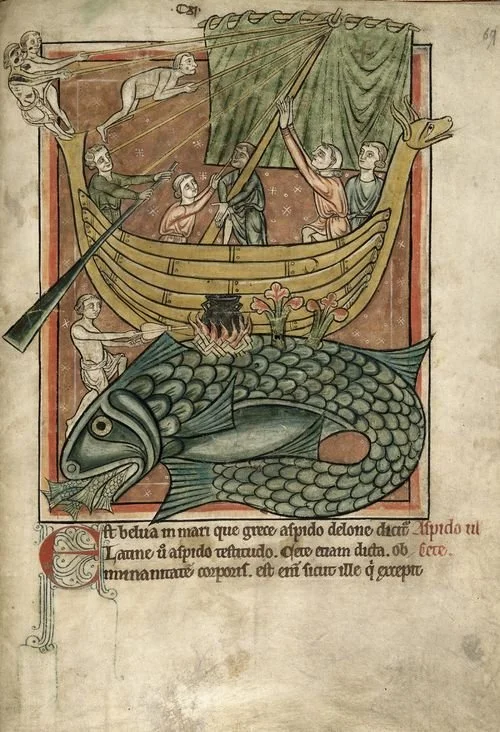
An island is actually a ‘whale’, 13th century. British Library, Harley MS 4751, f. 69r. [bl.uk]
We see similar fears of the unknown in Medieval and Renaissance maps, where whales are frequently portrayed as monstrous composites, sometimes attacking ships. The whales in Olaus Magnus’s 1539 map, Carta Marina, don’t look much like real whales; they have two blow holes like baleen whales (including blue whales, humpbacks and minke whales). Oddly, however, they have teeth like toothed whales (including orcas, dolphins and sperm whales), and scales like a fish. Presumably the artists never got a good look at the real animals, they would have drawn from the conceptual idea of them, disseminated in bestiaries and in folklore.
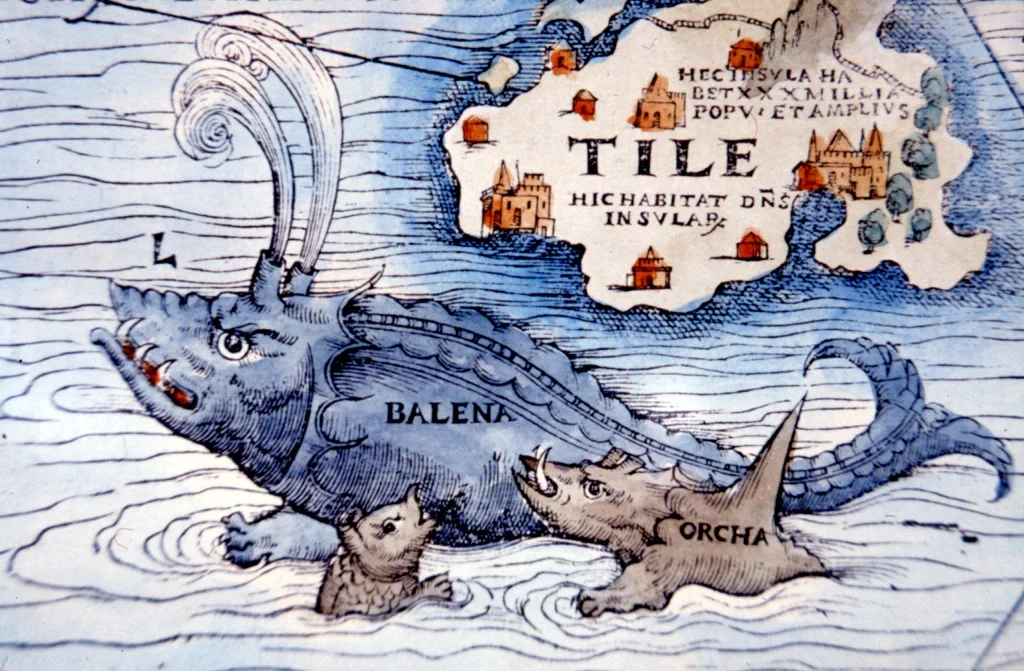
A ‘balena’ whale is seen suckling its calf, but they are under threat from an orca.
Coastal communities abound with stories of sea monsters, many of which sound a lot like misidentified whales. The kraken sounds much like a humpback whale, known for ‘trap-feeding’, in this mid-13th century Old Norse description of it from The King’s Mirror: ‘Meanwhile the monster keeps it mouth open, and inasmuch as its opening is about as wide as a sound or fjord, the fishes cannot help crowding in in great numbers.’ When humpback whales trap-feed, they stay still at the surface, mouth agape vertically, to encourage juvenile fish to find shelter there. In Norse folklore there’s also the Jörmungandr or Midgard serpent, a great monster of the world sea, coiled around the earth and eating its own tail; in bestiaries it is sometimes said that whales do the same thing.
By the 16th century, Renaissance artists were increasingly focussed on naturalistic accuracy over symbolic expression. Knowledge became more standardised, accelerated by the invention of the printing press which put millions of books into circulation. Even if a Renaissance artist didn’t see a stranding firsthand, there were more visual and written records to corroborate or copy when producing their own. And there were more opportunities to see a whale outside the ocean, as whaling took off on a large, commercial scale.
In a recent article for BBC Culture, I wrote about how Moby-Dick helped transform the image of the whale, offering a blueprint for how we might transfigure our relationships with other animals. In it, I detailed the harrowing true story on which it was based, of nautical survival and cannibalism at sea. Moby-Dick showed us that our human perception of whales as sea monsters, as Leviathan, are projections of our own disavowed fear of the unknown, and disavowed guilt about how we treat other animals.
In the last few decades, we’ve come to reappraise whales for their mystery, colossal mammals who breathe like we do but who have made the ocean their home again. We’ve been enchanted by their song and by their behaviour which invites us to project onto them more positive stories about what they are doing.
Scientists are quick to quell ideas about an ‘orca uprising (orcas are dolphins, actually a kind of toothed whale)’, but the truth is that we don’t really know why orcas are sinking boats in the Strait of Gibraltar. We do know that they are smart animals who remember traumas and pass down knowledge through generations; like Porphyrios and the real Moby-Dick, they have good reason to fear us.
If we learn to see past ourselves, we’ll find very different creatures.
In The Book of Beasts, I interviewed Nan Hauser, a whale scientist saved by a whale, and relayed strange stories of Vietnamese fishermen rescued at sea by humpback whales, who worship the Whale God Cá Ông. It’s tempting to imagine these as fictions, as anthropomorphism, but research has identified altruism in humpback whales, who save other marine animals like seals and sunfish from sharks. What else are we missing through our irrational servitude to the dogma that nature is cruel or indifferent? A lot.