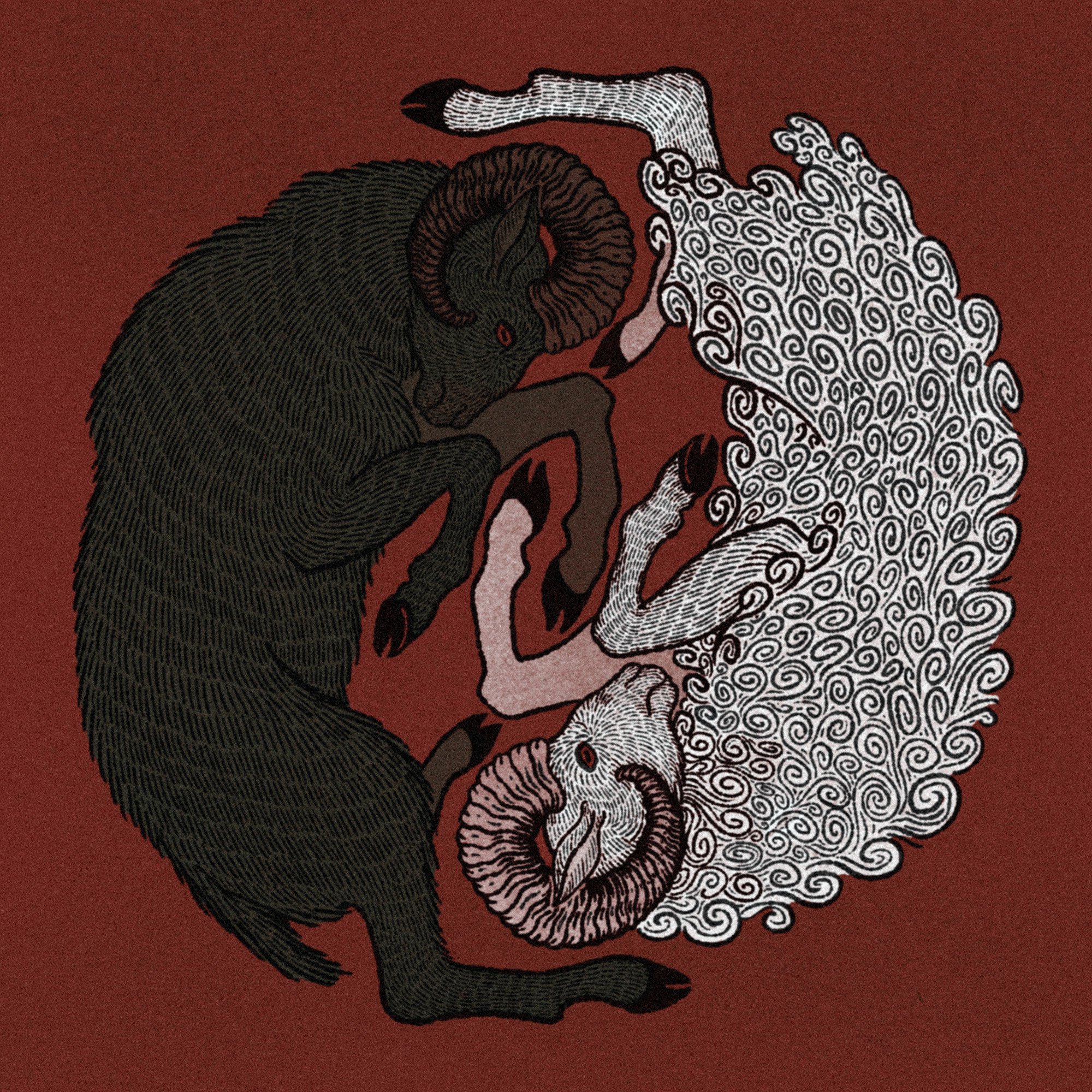
Illustration © Kaitlynn Copithorne
Recently I went to a local bookshop, and for the first time since we started publishing, noticed that Cunning Folk was no longer featured in the occult section. Instead it sat beside other literary magazines. I can only surmise that’s because our current issue’s front cover is not dark and earthy, but pink. I want to talk about why we made this decision, and why I think it matters.
Let me first make something clear: I love darkness. I love horror. I am drawn to what lurks in the shadows. But over the past few years, I have been thinking about our use of the term ‘occult.’ Honestly, it was on my mind from the very beginning; I didn’t want to perpetuate stereotypes about what the occult is or isn’t.
The term itself just means ‘hidden’, but it is certainly a loaded world, conjuring in our minds a very specific type of aesthetic, and so often we are looking to have our preconceptions about culture affirmed.
What does ‘occult’ bring up for you? Many minds first jump to demons, devils, arcane powers, witchcraft, curses. I am interested in these things; they validate our fears and feelings that there is more to this world than meets the eye.
There is, however, something about the term that sits uncomfortably with me. What is occult but the strands of belief and story repressed, ridiculed and demonised?
Page through any 19th-century-early 20th-century book about non-European culture, and you’ll find the folklore and rural religions of Indigenous peoples described as ‘occult’. Just recently I found it reading a European’s account of visiting a marginalised community in China and claiming local people attributed white gibbons with ‘occult powers.’
It’s colonialist, it’s orientalist, and it demonstrates an inability to see complexity. Where practitioners or adherent to a certain spirituality might regard a custom or spirit with ambivalence, the orientalist gaze sees it as all good or all bad – it’s as diluting as the disneyfication of djinn as spirits who grant wishes, but arguably more offensive.
In many regions with Judeo-Abrahamic religions, deities, spirits, fairies, or idols are all misrepresented as devilish or demonic. Baal, for instance, crops up in the Lesser Key of Solomon, but was actually a god associated with bulls and thunder among the Canaanites; Eliphas-Levis’ portrayal of Baphomet – which culture has claimed as the archetypal devil image – was based off Herodotus’ description of a god worshipped by the Mendesians, described as part-man, part-beast (that’s why, Herodotus said, the people there did not eat goat). And the ‘all-dark’ occult aesthetic also denigrates rural folk cultures in Britain. Communing with water spirits is misconstrued as summoning ancient monsters. Local customs which celebrate the return of the light are reframed as dark, mysterious and weird. Having grown up in the rural west country, a lot of the customs I participated in are really quite ordinary, though in some spins, they are portrayed as folk horror, recalling the brutality of horror films The Wicker Man and Midsommar.
My discomfort around the term ‘occult' came to the fore more strongly in the past couple of years, as I worked on a book which involved speaking with Indigenous leaders. In our conversations, I avoided the terms ‘occult’ and ‘magic’ for shame of what they often represent: a dualistic, reductionist understanding of complexity. A demonisation of marginalised spirituality and of nature. As one scholar of Ojibwe language reminded me, ‘your devil was once a god.’
Maybe it sounds less cool, but when we talk about the occult, we’re often denigrating what was or is someone’s spiritual belief – often marginalised or common people’s beliefs. These are every bit as valid as other religions but have less power; they are to mainstream religion what dialects are to standardised language. The way we so often imagine or curate the occult owes much to the Victorian rebrand – and this was in a time of empire and standardisation.
Before the times of empire-building, and in other non-dominant cultures, ‘occult’ didn’t have these same tunnel vision connotations.
Briefly, in the ancient world, divination, spirit communication and magical rites were viewed with more ambivalence, and were part of the religious landscape. The unknown was approached with caution but also respect. Other non-dominant cultures continue to have a more complex relationship with what lies beyond our full understanding.
By the Middle Ages, in western culture, non-Christian beliefs and customs were increasingly rebranded as heretical and demonic. Heresy was a precursor to the witch trials, wherein innocent people (who probably had beliefs that deviated from the dominant school of Christianity) were killed.
We see echoes of this in regions colonised by European forces in Latin America and sub-Saharan Africa today, where complexity was diluted by dualistic notions of good and evil, where shapeshifters and healers became evil witches, where beliefs in water spirits were rebranded as a realm of demons (see the Marine Kingdom).
Not all occult knowledge was condemned between the Middle Ages and early modern period – John Dee, for example was a court magician. Cunning-folk were still respected. But there was an increasing antagonism towards spiritual diversity. Folk beliefs were recast as superstitions, if not demonic. After centuries of persecution, folk practitioners would be ridiculed, and then non-standardised beliefs would go underground. Like other things we culturally repress, non-standardised spiritual beliefs became increasingly fetishised.
So often when we employ the word ‘occult’ and illustrate it with an exclusively dark aesthetic, what we’re doing is reiterating the language of the inquisition. That the unknown corners of the world are malignant. That other people’s religions – including those of marginalised people and the working classes – are ancient, dark, uncivilised and tinged with horror.
Very often, the dark occult aesthetic is used for personal gain, presented as an interesting personality quirk, even when it’s part of an edge lord package that is rather ubiquitous in the general population. Having grown up with these things, I cannot help but think those who fully lean into this language and aesthetic have been shielded from it to an extent they demonstrate their normalcy rather than their weirdness. Even the word ‘weird’ has morphed in meaning, deriving from the old English Wyrd – something akin to fate – which over time changed meaning to ‘unusual’.
The occult is not intrinsically bad. Again, stripped of its cultural associations, its meaning is quite innocuous. But the Western Occult didn’t only fetishise and demonise marginalised beliefs, it also cherrypicked terribly from non-Western sources while the UK state repressed those cultures. The Theosophical Society, for instance, borrowed heavily from Buddhist and Hindu sources and repackaged them into its universalist esoteric package. Aleister Crowley repurposed yoga and other beliefs from South Asia, the Middle East and Egypt for his religion Thelema. These ideas were then diluted.
Culturally appropriated beliefs from the UK, Europe and elsewhere became standardised, and new religions which promised people an alternative to the hard-sell of capitalism continued to sell a multilevel marketing-like self-focussed path towards enlightenment – but it was often yet another commodified and hierarchical self-development programme. Very often, the aesthetic casing of these new religions was different, but the spiritual objectives had more in common with those of capitalism. For example, Wicca borrowed the belief in karma for its threefold law but made it more anthropocentric – harm people and the harm will come back to you – whereas in India this concept is seen in much broader terms, as care for the more-than-human. People can reincarnate into animals and vice-versa. While these new religions often aestheticised the natural world, practically speaking, they did little to foster environmental stewardship where it really matters.
Leaning into the darker side of the occult can be empowering for marginalised people who seek magic as a means to level out inequality; it can be a source of resilience; those at the lower rungs of society might find solace in wishing those who wronged them bad will, or a degree of power in cursing. Along similar lines, a lot of what we associate with dark magic or misfortune is probably disavowed guilt, from the wild hunt cursed to forever hunt across the skies, to the Ox King of Song dynasty China, who punishes those who mistreat their cattle with bovine rebirth.
Where does that leave us, then? Cunning-folk were service magicians and healers in the UK and Ireland who drew from a variety of sources. They were valued and respected, sometimes viewed with caution, but they were not witches. ‘Witch’ is a word from the mouths of the accuser.
With this magazine, I have never sought to reiterate the language and prejudices of the inquisition or of colonialism. As a team, we hail from four continents and diverse backgrounds. Nevertheless, we have always been positioned in this space; the very mention of the word ‘occult’ gives people a preconceived idea of what our content will be about.
I feel similar discomfort towards the term ‘folk horror.’ What is it but confirmation that common folk culture is uncivilised, that rural communities will violently sacrifice other humans and other animals, as Tacitus remarked of the Ancient Britons; a recurring theme in folk horror is that folk religions are siren-like; aesthetically beautiful, yes, but ultimately dangerous.
Again I love horror, but what am I scared of? It is certainly not marginal folklore or our last native forests or the animals we are fast losing to unprecedented ecosystem degradation. I am more scared of what William Blake called the ‘dark satanic mills’ and what Tolkien’s Ent Treebeard called a 'waste of stump and bramble’. I am scared of a world robbed of meaning and stripped of life. I am scared of wasting each precious year filling in my tax return. I am scared of the violent ideology underpinning capitalism. Increasingly, I feel the word ‘occult’ doesn’t quite encapsulate, at least in everyone’s minds, the thing that I aspire to, which aligns more with spiritual ecology, reclaiming ancestral knowledge and connecting with truths not tied to antiquity but ever present, if we pay attention.
Of course, we can reclaim the word ‘occult’ for ourselves – it is part of what we are doing. Reframing the occult in more holistic terms, as both light and dark, there is still room to validate our fears and our insecurities and to seek empowerment. Ghost stories acknowledge our fears of death and time’s passing; supernatural horror gives form to our fear of the unknown and infinity. Stories of vengeful spirits and curses force people to confront inequality. Place spirits remind us how little we know the world and how, really, we seem to know – at least deep down – that we should share our space more than we do.
We can also reclaim the term ‘witch’, to express solidarity with the scapegoat. And we can reclaim the term ‘folk horror’, as Hollie Starling does in her anthology Bog People: A Working Class Anthology of Folk Horror; after all, if the affluent are scared of the common people, doesn’t this spell an opportunity for resistance?
We can reclaim a word, but we have a responsibility to not perpetuate the message of the inquisition, that the unknown – or anything that lies outside standardised culture – is a wholly dark, devilish and terrifying thing. It is also the source from which dreams, stories and resilience are borne.