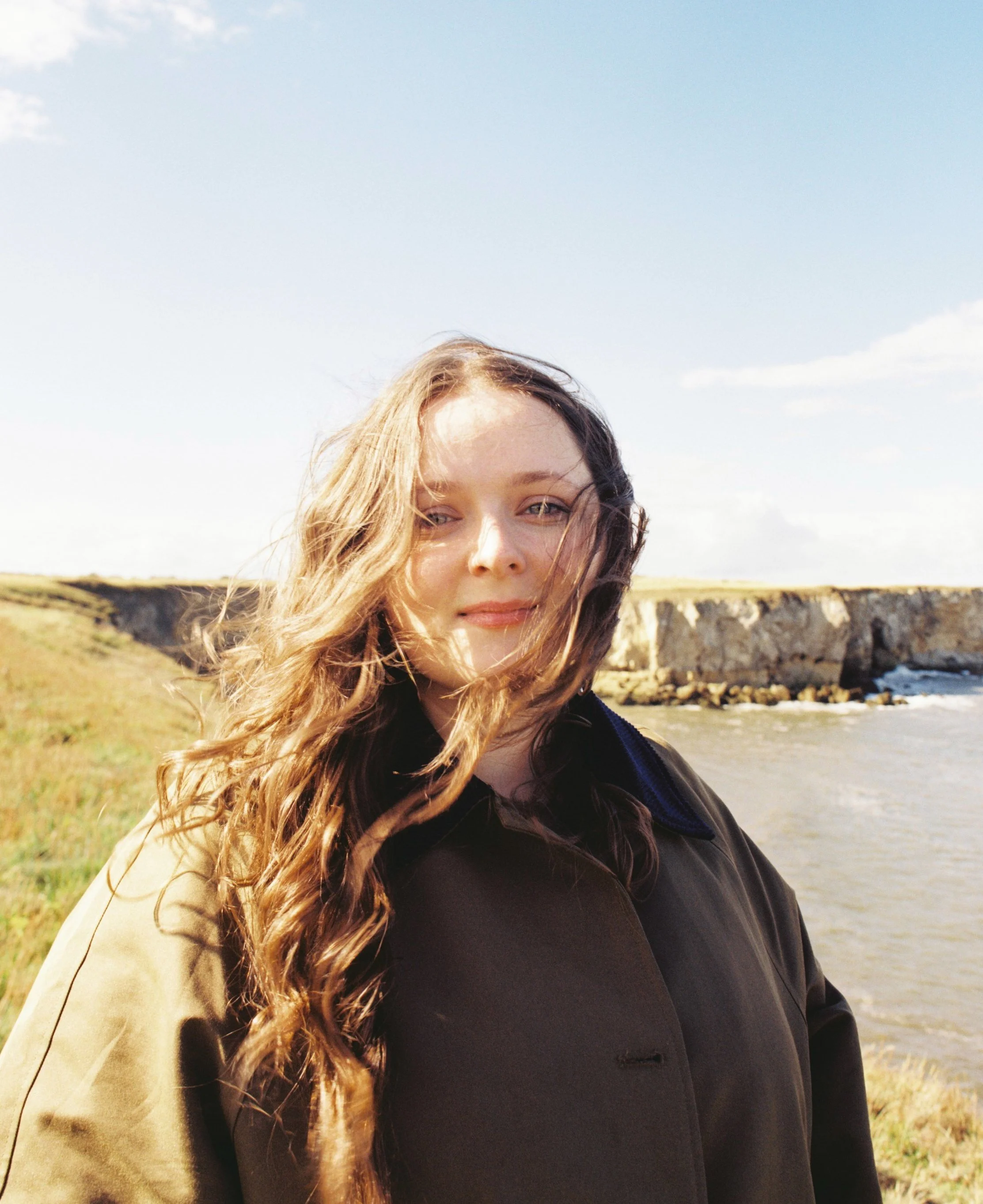
Image © Ellen Dixon, Phantasmag
Lucy Rose is a multi-award-winning author and filmmaker from Cumbria. Her debut novel, The Lamb, instantly entered the Sunday Times bestseller’s list when it was published in 2025. A literary horror about mother and daughter cannibals in the Cumbrian Fells, The Lamb has been called ‘femgore at its finest’ by People Magazine and ‘[a] superbly creepy folk-horror tale’ by the Financial Times. Shortly after winning the Nota Bene Prize 2026, Lucy spoke to Sophia Adamowicz about the folklore and landscape that inspired her book. This interview has been edited for length and clarity.
Sophia Adamowicz: Congratulations on winning the Nota Bene Prize, 2026! Why do you think the book has resonated with so many readers?
Lucy Rose: I think I've reached a lot of young people who are starting to read literary fiction, and I've found that there's a lot of people who are really interested in human connection via digital spaces, which I find fascinating, especially because it's folk, and folk is so analogue.
Also, a really large portion of my readers are people who are disabled. People have spoken openly about experiencing things like neurodiversity and the loneliness that comes linked with that. It makes me so happy that I’ve found that corner of my readership, because I'm neurodivergent and that was so conscious in my mind in terms of the writing style. The chapters are so short and digestible. Because I have ADHD, I struggled with reading; growing up, it was something I wasn't very good at, and I felt like I wasn't the most academically gifted student, and I think it's because a lot of those issues were undiagnosed. So, I wanted to make the book as accessible and easy to read for that subsection of people who love reading but just don't realize it yet. It's important to me that the book felt like a gateway and didn't feel like a book that you could only pick up if you were an experienced reader.
I love how many outsiders are drawn to the book. It’s all about feeling like an outsider in your own home. That I’ve found my people—that group of potentially quite lonely people who are really vulnerable and just want to have feelings and feel included—means a lot.
I didn't even ever imagine it was going to get published, so it's still a little bit of a shock to me that it's a real book out there and people are reading it.
SA: Do you think it is their outsider status that attracts some readers to folklore?
LR: Yeah, for sure, 100%. For a really big portion of my childhood, I didn't have a TV, and so oral storytelling and folk tales were my way in. Oral stories filled the chasm that was my inaccessibility to reading and to films and television.
These familiar stories have been passed down since humans could speak and communicate, which is roughly 200,000 years now, across cultures, and you see the same formulas in every corner of the globe. I feel an immense comfort knowing that 200,000 years ago, somebody was looking for the same thing that I am. It feels like this multi-generational hand squeeze that I look for constantly in life, because I like to feel connected to the humans that came before. What folk does for people that other kinds of spaces can't achieve is create this sense of a really long history and a sense of heritage and culture.
It can make people feel so much less alone, knowing that some of the things we experience are manageable because they're universal—and because they've been universal for so long, there’s a comfort in that. We know we're going to be able to get through it.
SA: And some of these experiences are heavy. Did you get any pushback from the industry because the themes of your book are so dark?’
LR: Surprisingly, no! I was very fortunate to work with a group of people who were very unflinching and forward thinking. There was lots of talk about the ending and how we could make it work, making it feel cathartic, whilst still maintaining the very real reality that domestic violence situations don't always have happy endings. We were very conscious of Margot and being as respectful as possible—studying the line of where the horror met the very real domestic violence that's taking place.
SA: What do you think literary horror is? Why or how is it different from horror?'
LR: This is a great question and I don't think there's a formal definition. For me, literary horror is less commercial and more themes/allegory driven and often comes to life as more of a deep character study than a 'The Conjuring' style, more plotty horror. I love all horror, whether it's formulaic or art house, or anything in between—I think the term 'literary' or 'elevated' is just a way to describe the small subsection of horror that is less The Housemaid by Frieda McFadden and more Fish Tank by Andrea Arnold.
SA: You noted that folklore makes people feel less alone. Could you tell me a little bit about that oral storytelling that inspired The Lamb? Were there any stories you heard as a child that you think fed into this book?
LR: The Croglin vampire was the story we told each other at the back of the school bus every day. It never got boring. The Croglin vampire is a fascinating story; it's not a traditional book tale, in the sense that it was found in an 1800s self-published biography that [Augustus Hare] wrote himself, and there's a whole chapter dedicated to a dinner party where this story was told to him about a grange in Croglin, which was on one of the bus routes. I swear we’d just make it up: we'd be like, Oh, yeah, someone went in and there was blood all over the walls, and we’d try and absolutely frighten the life out of each other. It was really funny and also really warm.
I wish I could go back for a second into those moments, because feeling scared as a child is so different to feeling scared as an adult. You look back and miss that sort of fear which is less real.
That story was so pivotal for me because it's the one that kept being told, and you'd hear it the next day slightly changed and feel like the whispers were evolving it in real time, which is how folk tales live. I don't view folk tales as being static things; they're shifted and changed with every mouth that speaks them.
I grew up in Cumbria where there were lots of little beasts, like the basilisk worm and the cockatrice and tizzie-whizies, which are the sweeter, more angelic folk that you'd probably associate with Beatrix Potter or something. They were like hedgehogs with fairy wings and little antennas. I feel really lucky because I grew up very rural, and it's such a privilege to grow up rural. There’s a sense of magic hidden in every nook and cranny.
We also used to run into the woods and set fires and tell ghost stories. We’d tell the scary story, and then we'd sit in the woods all separately and I'd find myself shuffling to be able to put my back up against a tree. The idea of there being nothing behind me, that absence, really freaked me out—it's the physical response it conjured in me. We were also those stupid kids doing ouija boards out in the field. You know, you finish maths then go and do a seance. I grew up in a place where I genuinely felt like magic was real and there was this connection to other worlds that I could access.
Even though I feel grief about books that I could have read as a kid if I'd only engaged properly, and films and TV I wish I felt nostalgia for as a grown-up, the imagination that I had is largely a response to that in a weird sort of way.
SA: What is it about the landscape of the Fells that you think is so productive?
LR: It is a landscape that I know so well, like the back of my hand, and even though I don't live there anymore, I could walk you the paths of that wood like I was there yesterday, even though it's been 15 years since I went back.
The history of the Cumbrian landscape is so fraught. It’s on the border between England and Scotland, so it was constantly fought over and pillaged. There’s a lot of very quiet trauma that people probably don't talk about or hasn't been fully uncovered, simply because there's not a lot of historical records.
The landscape has changed and shifted because of all of the things that have happened to it, for instance, the plague, the civil war in Newcastle, and how much bloodshed there was, and then the Newcastle witch trials. All of that grief is so strange.
Then also you've got the other influences: the Romans came over and changed all the place names except for Carlisle, which was owned by Scotland at the time. This stripping something of its name and replacing it with something different, I find really interesting. And you can still hear the Norse in the language and the dialect of the way that people speak. So there's all these fascinating tiny clues about what happened there. Nobody can fully understand the scale or even the intricacies of what happened. I find that quite frightening. There's an ambivalence, an ambiguity in the land that I'm drawn to and loved trying to unpack very quietly in the background of the novel.
SA: When Eden tells Margot her name, Margot asks, ‘Like the river?’ and Eden replies, ‘Exactly like the river.’ She seems to be a Cumbrian nature spirit, but she's also a vengeful woman. So who or what is Eden? And branching off from that, how important do you think religion is in The Lamb? You can't get away from thinking about the fall of humanity in the garden of Eden.
LR: What's fascinating about Eden is I never intended for there to be a religious connotation. However, that does not stop the touches of religion creeping in, because the fact is, there's a river named the Eden River, whether we like it or not.
There’s a sense that religion is everywhere. It's in the things we call our rivers and our becks and all of these things in nature. Eden is fascinating because, to me, she does represent nature. She is beautiful and she is terrifying. If I was around her as a person, I think I would both be in awe and absolutely petrified.
I grew up in Cumbria when all of those really, really terrible floods were happening. There was a beck that I used to play in all the time. I loved water, but I grew up around the Carlisle floods where it was destroying homes and it was so powerful—there's nothing we can do as humans to stop it. If it's entering your home, it's entering your home, and that's the top and bottom. You just need to leave.
In Morecambe, a horrid thing happened to those cockle pickers who got caught in the quicksand and drowned, and their voice messages to their loved ones were broadcast on the radio for us all to hear on the school bus.
The connection to water for Eden is absolutely essential. Humans are so powerful, and we control so much, we think. But actually, something as simple as water can cause so much destruction and havoc, and yet it's also something so beautiful that people go to the sea just to look at it.
But you can't get away from how religion and faith has touched the landscape, especially in rural areas; it's everywhere, and religion is still largely across the world practised more in rural areas than it is in urban areas. When you are surrounded by not that many people, I think people are drawn to those community spaces. Even if I didn't intend it, it's actually so much bigger than me and my intent, because the religion has still touched Cumbria so much as to name its biggest river Eden.
In terms of Eden embodying a spirit: a huge pop source of inspiration for me was Spirited Away, the studio Ghibli film. It's my favourite. A character in the story is the personification of the river, Haku—the beautiful dragon who was the river that Sen lost her little shoe in. It’s a folky film, even though it's utterly bizarre and jarring and beautiful.
I love that humans are great in some ways; even though we do all sorts of terrible things, we see ourselves in rivers and forests. I hope that’s something that stays in my work forever.
SA: You’ve received accolades as a filmmaker. To what extent has your filmmaking impacted on your novel writing?
LR: What film is really good for is immersing you in a world. Every medium has its strengths and weaknesses, and film has the sensory aspect: it can play with sound and colour and texture in a more overt way, which books can do, but can't do as well, simply because they’re not a visual medium.
I’m all about the sensory. There are popular, massive books I haven't been able to fall into simply because they aren't sensory, and I can't feel the textures, I can’t smell what's in the oven. I want to feel like I've lived there my whole life when I step into the first pages of a book, and what I like to channel into my writing is making somebody feel like a part of the furniture or a picture on the wall. It’s such an important part of writing.
SA: I was also struck by what you were saying about the cockle pickers. It reminds me of an earlier bit in the book where Ruth takes Margot to the beach and explains about the ghosts in the quicksand. To me, The Lamb is a ghostly story. Are there any particular ghost stories that have stuck with you?
LR: Ghost stories… where do I even begin? I love ghosts so much. I have some Ouija board stories that are really scary. Not scary in sort of the traditional Hollywood scare, but uncanny and weird.
[Ghosts are] so interesting to me and culturally significant. I hope one day that I get to write a really good ghost story. We do have some haunted spots in Cumbria that are fascinating—obviously Carlisle Castle. Cumbria is a space where country roads go on and on forever, and people who do not believe in ghosts at all will tell you, I saw someone at the edge of that road, and there was nobody for miles.
I think ghosts often come from a point of grief, a cultural grief, and you see it across other cultures as well. I think you see it a lot in America specifically. In the 70s, there was a resurgence in ghost fiction that involved the Native American community but framed in a really negative way. There was lots of weird fiction around vengeful spirits and, culturally, I think it stems often from grief or guilt. In America, there's cultural guilt around what happened there and what the British colonies did and how we treated the native people. To be honest, that’s probably the same for a lot of countries the British colonies touched.
I'm always fascinated by how that manifests regionally. When you look at Ireland, the folklore there is really strange and warped and the ghosts are also really fascinating, and what our country did to their country was unspeakable in so many different ways. These monsters really do stem from our pain, and that's why I love the cultural significance of them, because if we don't want to talk about the history, we can trace the rough approximation of what happened through our cultural responses.
SA: In The Lamb, we have hexes that can be both destructive but also offer hope. Are there any arcane or occult practices that inspire your creativity?
LR: I do lots of things with wishes. I don't like to call it manifestation, because it doesn't feel personal—that feels like capitalism has got its hands on it. I live by the sea, so I take lots of stones and I’ll either write my wishes on them or tell them my wishes and chuck them in the water.
I really like my quiet reflective time in nature. Often, I will leave my phone in the house for hours and hours. I'll go somewhere like the cliffs and stand at the edge and look out at the water and try and clear my head, and also think about things that are difficult to think about.
That very quiet sort of spiritual time is really important for creative people the more we go through history and the more we dive into this technologically advanced era where everybody has 24/7 access to us. It’s quite surreal thinking that, at any given point, someone can go on my profile and be like, feed me content of this person. That time away from everybody and being able to sit and be human is absolutely vital and really helps me get to the point of the questions I want to ask and the things I want to untangle.
The Lamb by Lucy Rose is published by Weidenfeld & Nicholson and available to purchase from bookshops everywhere.