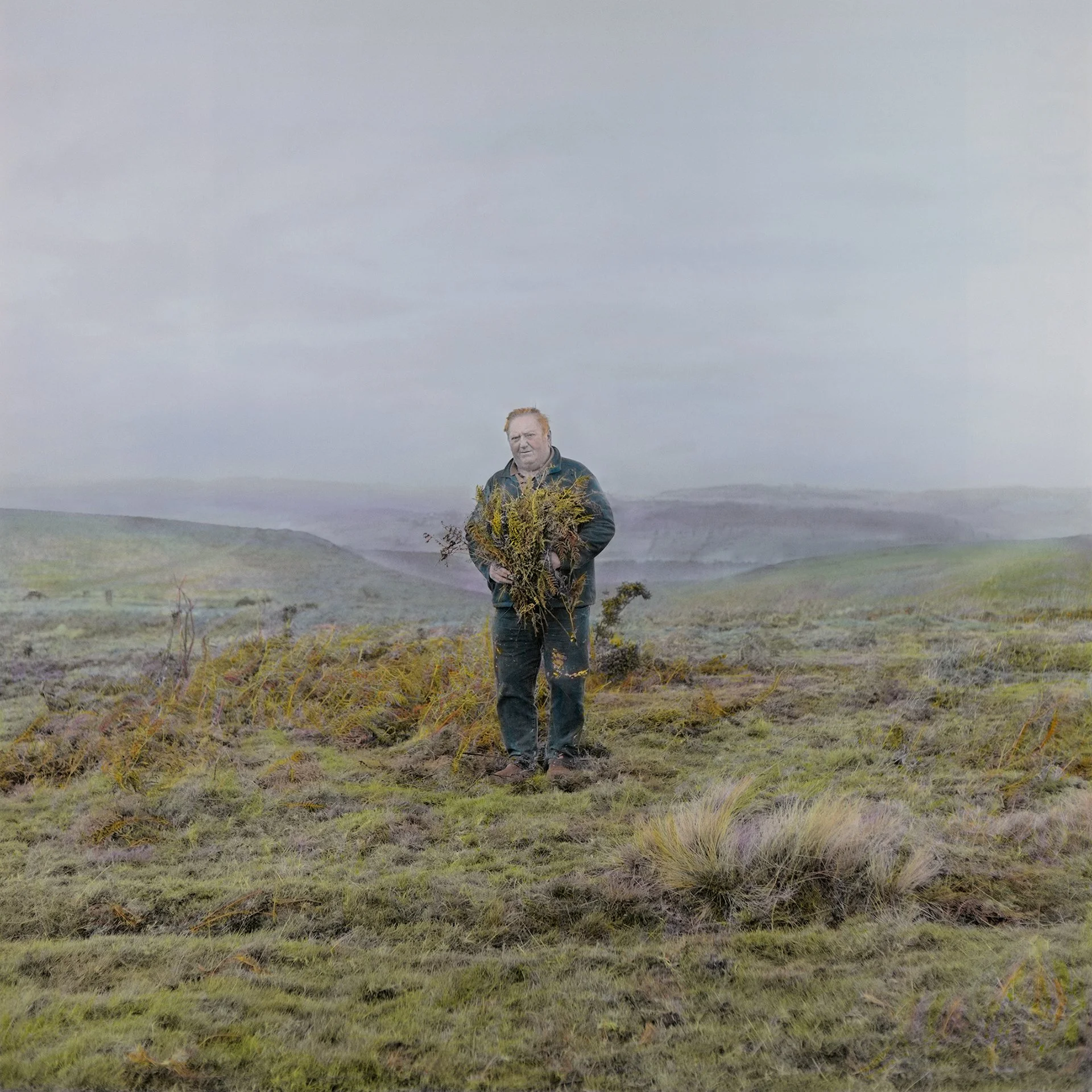
Roy Griffiths, Stapeley Common Rights: grazing cattle, sheep and horses; estovers (bracken) (2020) by Leah Gordon (hand-tinting by Marg Duston)
Artist Leah Gordon’s work has been exhibited internationally at places such as the Museum of Contemporary Art in Sydney and the National Portrait Gallery, UK. Recently she collaborate with writer and curator Stephen Ellcock, co-writing Common People: A Folk History of Land Rights, Enclosure and Resistance (published by Watkins, 2025), with additional writings from researcher Annabel Edwards. ‘In 1600, 50% of England was common land,’ says the publisher, ‘it’s now 3%. This is the story of how it happened.’ Through archival paintings and photographs of folk customs, and Leah Gordon’s photography, the authors paint a picture of centuries-old land struggles and folk resistance. We spoke with Leah about the making of the book and the decades of work and thought that fed it.
Elizabeth Kim First, I love that you call this a folk history, but also the fact we have to distinguish between official records – so often about the drama of the elite – and the history as remembered by the people speaks volumes. For you, what makes this a folk history? And what might History with a capital ‘h’ neglect?
Leah Gordon In the final scenes of my film, Kanaval: The People’s History of Haiti in Six Chapters (2022), one of the narrators states, “We carry Haitian history in all of our bodies and this history manifests in everything we do….…in our song, dance, and religion. But especially through our carnival.” For me this is a clear expression of the corporeal transmission of history…the way in which grassroots folk traditions can animate tales of struggle, joy, collectivism and our roots in the seasons and nature. Born into a less performative culture and more mundane religious framework in the United Kingdom, I quit studying history at the age of fourteen. Some instinct told me that ‘the fetid queue of Kings and Queens was not my history’. I opted out of history and, as a consequence, for many years was blind to the intense beauty and profound insights that can be garnered from the many forms of knowledge of the past.
In my early twenties I heard of a book, The People’s History of England by A.L. Morton. At the time the sheer audacity of the sight of those two words side by side had quite an impact. This was my first experience of ‘history from below’ and the universe clicked into a more fathomable cosmos. This was the first acknowledgement that there could be a history of the peasantry and the working class, marked by the struggles alongside brutality and losses. But more than that it was an acknowledgement that history could be on the side of the angels and reilluminate the past with a radical flame.
So for me ‘folk’, ‘people’s’ and ‘grassroots’ histories are all forms of ‘history from below’. Many texts about history from below are foreshadowed by the poem “A Worker Reads History” by Bertolt Brecht. The first three lines sum up the re-examining of ancient monuments to power from the position of the worker, the majority class, the subaltern:
“Who built the seven gates of Thebes?
The books are filled with names of kings.
Was it the kings who hauled the craggy blocks of stone?”
This is a stalwart battle cry for the people who built ancient civilisations rather than ruled them.
EK Absolutely. So, what first brought your attention to the history of the enclosures and how this impacts common people?
LG The Many-Headed Hydra by Peter Linebaugh and Marcus Rediker, was the first history book I had read that placed the enclosures as utterly central to understanding British history. Then I read the tremendous, Caliban and the Witch’ by Silvia Federici, which situated the enclosures as fundamental to understanding the oppression of women through the witch-hunts. I was particularly taken by her assessment that one way of breaking our relation to the land is through the demonisation of our sacred traditions and rituals that bind us to the land. This, for me, is one of the absolute core impulses behind this current resurgence of folk traditions…a need to not only articulate and theorise about the environmental breakdown but to more profoundly embody our primordial entanglement with nature.
EK You have been taking photographs of common land struggles for decades now. Can you tell me a little more about what you set out to look for?
LG I would not say that I was consciously working on ‘common land struggles’ for decades but rather that this was a culmination of a trajectory of preoccupations that have engaged me for almost thirty-five years. From the feminist folk punk band, The Doonicans, that I wrote lyrics and sang for in the mid-eighties; to my image-making of British folk traditions; my involvement in the road campaigns in the 1990’s; my film, book and exhibitions on Haitian carnival as well as my Channel 4 documentary about Haitian peasants, their pigs and US imperialism.
I wanted to ask the question why we have no monuments to the enclosures, which was, for the majority of the English people, one of the most brutal and life-changing events in English history. More profoundly this story has greater meaning for me because my grandfather, Jesse Walker, was a farm labourer who was divorced from the land surrounding Ellesmere Port when it was compulsorily purchased in 1948 to build the oil refinery Shell Stanlow, where he and many others from my extended family, including my father, were finally employed. But it does please me that he continued to poach with ferrets until his death!
EK Can you tell me about three photographs from the book? Who or what are we looking at and why does it matter? (The embedded images are just for recognition and I will send higher res via Hightail)
LG:
(Pictured above interview) Roy Griffiths, Stapeley Common Rights: grazing cattle, sheep and horses; estovers (bracken) (2020) by Leah Gordon (hand-tinting by Marg Duston)
Stapeley had a very loose system of rights until the Commons Registration Act of 1965. The formalization of rights led to several lengthy disputes between commoners in the 1970s. A centuries-old, communal attitude to the land has been lost, through of bureaucracy as well as enclosure. The small farm called Giant’s Cave, where Roy Griffiths grew up, is on the edge of the common. Roy’s father grazed sheep on the hill and cut bracken as bedding for their livestock as, according to Roy, “ as straw round here and it cost too much to buy”. (Caption by Annabel Edwards)
Roy’s story highlights the practical reasons for seemingly random common rights, such as collecting bracken.

The Burryman, South Queensferry, West Lothian (2010) by Leah Gordon
The Burryman tradition in South Queensferry is over a thousand years old; it maps boundaries, links humankind and nature, and binds a community. The role is open only to a man born there and requires deep commitment. On the second Friday in August, about 11,000 burrs (the scratchy, multi-hooked seed head of the burdock plant) are attached to an undergarment encasing the Burryman’s body, leaving holes for his eyes, nose and mouth. (caption by Annabel Edwards)
When I photographed this tradition, I followed them from the crack of dawn until early evening. One thing I learnt was that it used to only take a week to collect the necessary burrs but now due to the over-use of herbicides it can take over two weeks…this shows how past traditions can also be future markers for environmental degradation. The Burryman is also possibly one of many forms of the Green Man; although the exact roots are contested and possibly unknowable, the cyclical resurgence and importance of this archetype attests to a collective need for a deeper relationship to nature.
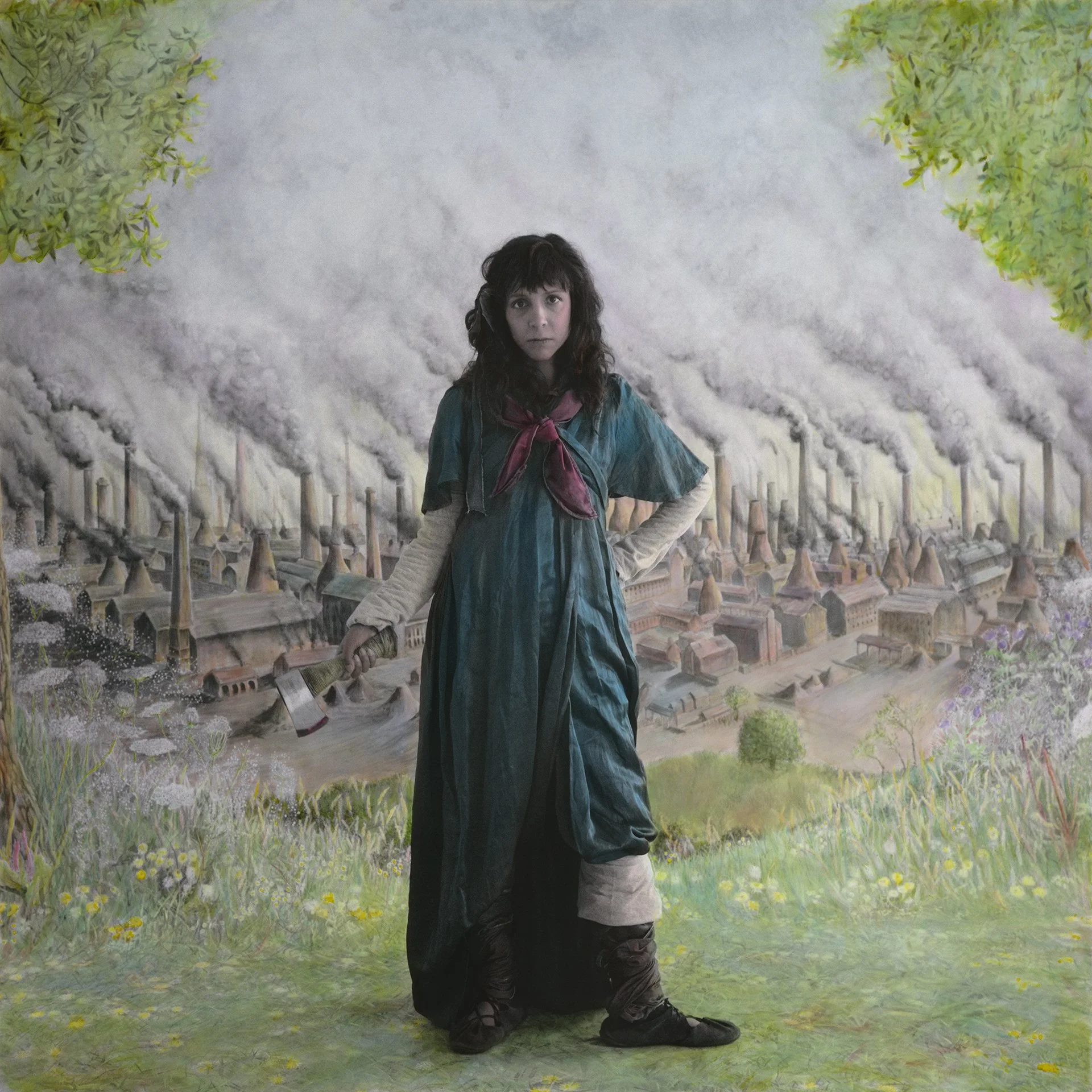
Luddite (2025) by Leah Gordon (backdrop painted and photograph hand-tinted by Marg Duston)
This is one of four portraits I did to try to consider the massive upheavals due to the enforced migrations from rural agricultural life to the urban industrial future. They were all placed in front on this backdrop, which was painted by Marg Duston for this project, which shows a sprawling industrial city framed by a rural foreground. Many male rural activists, from the Swing Riots to the Rebecca Riots, dressed as women. This enabled them to travel unheeded to the riot locations, as women were less likely to be stopped and searched. It also enabled them to conceal their identities and, it has been suggested, added an edge of carnival and theatricality to the protests. But women also took part in machine-breaking, as the issues affected their livelihoods too. Many people think of the Luddites as anti-progress, but they weren’t so much against modernisation as against the way in which factory owners were using machines to further exploit the workers.
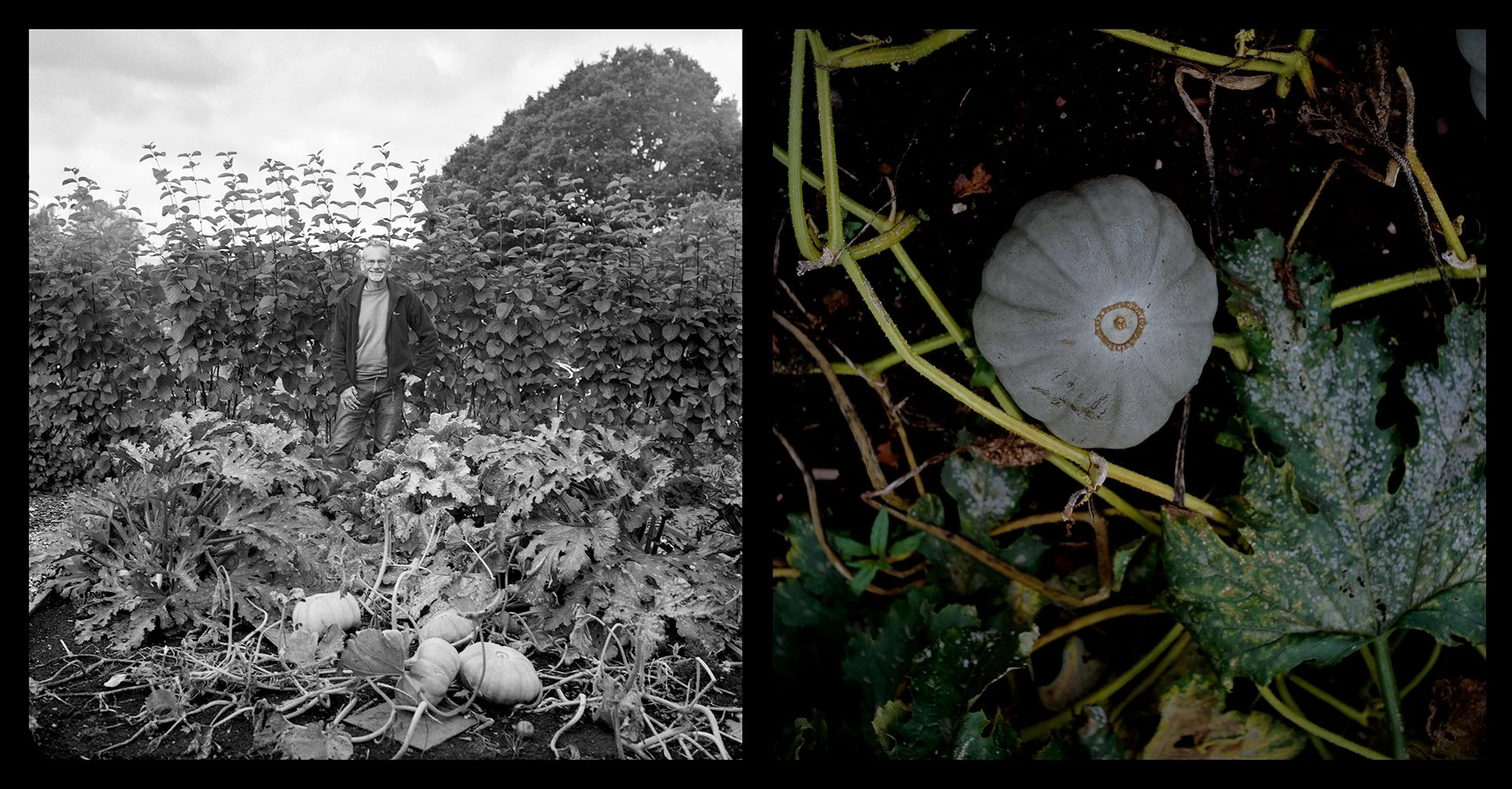
Peter Shipton - Crown Prince pumpkin (2024) by Leah Gordon
Peter is an allotment holder at Earlsdon allotments, Coventry. “The allotment gives me a peaceful time with nature in an urban environment. It’s good for both my physical and mental health and rewards me with organically grown fruit and vegetables throughout the year. The allotment is my happy place.”
I wanted the project to end on a positive note and photographed allotment holders in Coventry. The short-lived Digger settlements of St George’s Hill, where members of the dissident group the Diggers planted beans and vegetables from 1649 to 1650, could be considered the first examples of allotments in England and a radical attempt at reversing the abject losses of the commons. In the 19th century, the land available to the poor was greatly diminished, especially after the General Enclosure Act of 1845, which made the process of enclosure easier and faster to authorise. However, at the same time there was a promise of the provision of “small field gardens” for the landless within this act. This promise was further formalised and sanctioned in the 1908 Small Holdings and Allotment Act, which required local authorities to provide allotment gardens for their communities.
The allotments in Coventry are an example of positive strategies to reunite people of all races with the commons. The Coventry Labourers’ and Artisans’ Co-operative Society was set up in 1843 by the ribbon manufacturers James Cash and Charles Bray to provide allotments for their workers. Coventry still has many of them and these portraits of current allotment holders, or allotmenteers, in the city attempt to show how allotments represent the urban classes’ attempt to reverse enclosure and restore small plots of land to the landless. These are some of the few contemporary successors of common land rights, although in recent years there have been increasing threats upon the survival of some allotments due to incursions by landowners and property developers.
EK Which folk art or artists most inspire you?
LG Haitian ‘folk’ artists have most inspired me. Haitian art and culture is a potent vessel for continually transmitting, telling, retelling and reinterpreting its history. As such, art is primarily a tool to keep history alive rather than keep art history alive. Haiti is a country of low literacy and the image is essential. Every work of art from Haiti is either a chronicle of history or a very strong statement about aspirations or frustrated aspirations. Often Haitian art is considered an art without discourse and can be too easily dismissed. But this is an art that has found a language to keep a historic ball rolling…and a revolutionary history that has been written out of most global syllabuses. Thus it is an art which is transmitted via its own language of symbolism within the work.
EK How did you come to collaborate with Stephen Ellcock?
LG I met renowned image-collector and author, Stephen Ellcock, as he published a selection of my portraits of commoners in his beautiful book, England On Fire, published in 2022 and later my Burryman portrait in Elements, published in 2024. He is an amazingly erudite and informed speaker, so I went to many of his subsequent talks and got to know him. Our constellations of interests and areas of research intertwined so I do not even know at what point we decided to work together on the book and for him to contribute to the exhibition, but it did seem like a natural progression. Stephen brings a vast knowledge of archival art collections from around the world into which he sourced material which was a deep dive into the psyche of British rural life as portrayed by artists over the centuries.
EK You show that the erosion of land rights is a very contemporary issue, still impacting the most marginalised in society, and common folk's right to be free. Where do you feel the most impactful resistance is currently?
LG The modern British working class has its roots amongst the peasants driven off the land, but the history of enclosure hasn’t been treated as a significant part of a national discourse of history and has never been memorialised anywhere in Britain. I hope this project will address these historical silences and imbalances. This is especially relevant considering the new attacks upon British public land, which is being rapidly sold off, as our freedoms of movement are being eroded, and as we are increasingly aware that the majority, rather than an elite minority, need to have more voice in the future of our environment. Both the Open Spaces Society and Right to Roam are vital organisations currently organising around land issues and I do feel that small grassroots groups coming together to protect village greens and allotments are equally important.
EK And what can we all do to protect and seize back our local common land?
LG If I knew the absolute answer to that question I would be tracked down and summarily executed! The privatisation of land continues at a pace often with little to no public discourse or consensus but mentions of the re-nationalisation of land is always accompanied by a whiff of Stalinism and extremism. There is a strong case for the creation of a national strategy for land reform that could consider the nationalisation of agricultural land alongside ramblers access, allotment allocation, and very importantly the rights to demonstrate and dance in the streets and lanes of this country.
Common People: A Folk History of Land Rights, Enclosure and Resistance by Leah Gordon and Stephen Ellcock with additional writing by Annabel Edwards is published by Watkins Press.
Catch ‘Monument to the Vanquished Peasant’, exhibition by Leah Gordon, part of the Coventry Biennial at the Herbert Art Gallery and Museum commissioned by Meadow Arts 3rd Oct – 25th Jan

A Kentish rat-catcher by W. Collins. Courtesy of the Wellcome Collection.

The Shepherd, from Songs of Innocence, ca. 1795 by William Blake, courtesy of the YaleCenter for British Art, Paul Mellon Fund.
All images © Leah Gordon unless otherwise noted