In conversation with Francesca Lisette

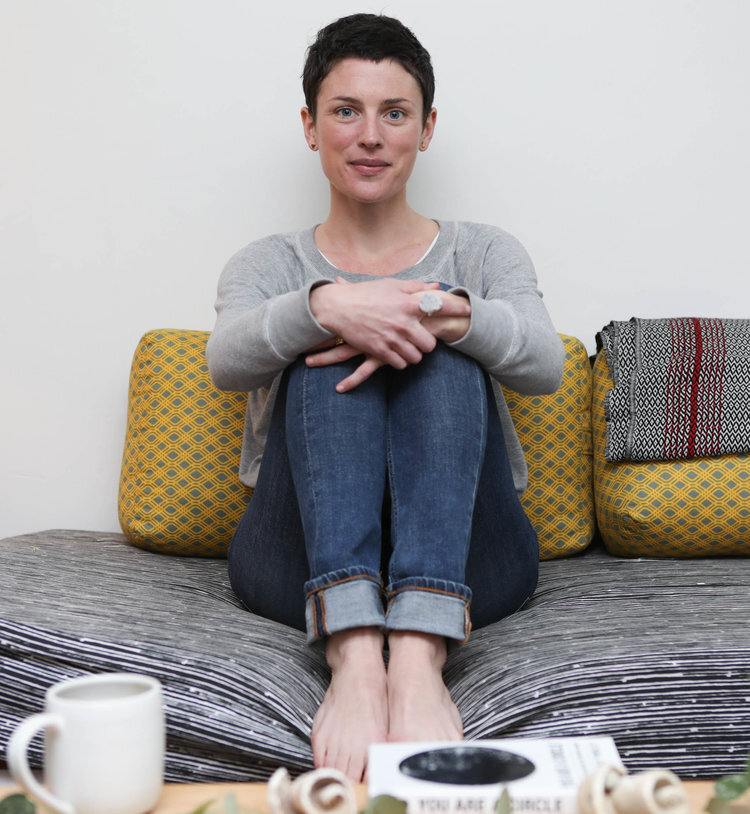
Francesca Lisette is a poet, astrologer, interdisciplinary artist, and creativity mentor based in London. They are the author of two collections of poetry, performance writing, and artistic ephemera: Teens (Mountain, 2012) and sub rosa: The Book of Metaphysics (Boiler House Press, 2018). They have performed their work in the UK, Europe, the US, and Australia. Work is forthcoming in the 2021 Athens Biennale catalogue and featured in the recently-released anthology Anthropocene of the Everyday (Dostoyevsky Wannabe, 2020). In Fall 2021, they are starting a PhD in Creative Writing & Literature at the University of Denver. Follow them on Instagram @fountainofiris.

untitled-28.jpg


MB How did you first become interested in astrology?


FL I grew up in an Air-sign (Gemini & Libra) family. My mother and sister share a birthday, and I was due on my father’s birthday. I arrived early, on-brand for someone with the Moon in notoriously impatient Aries! As a teenager obsessed with Buffy, nature & mythology, I started practising witchcraft and Wicca, collecting crystals and reading magazine horoscopes. But astrology really started to resonate with me when I looked up my own birth chart shortly before I turned 21. I’d had a tumultuous, life-changing year in which I was diagnosed with debilitating chronic pain, and this was the first opportunity to learn more about myself which came from a perspective which seemed truthful, empowering and kind. I felt seen objectively for the first time. From then on, I was constantly looking up charts, horoscopes and the meanings of placements online and reading classic books of modern psychological astrology, like Liz Greene and Steven Forrest. Around 2013 it occurred to me that I might actually be obsessed enough to practise astrology professionally, and a couple of years later when Chani Nicholas told me my chart indicated a strong natural affinity for divination, that sealed the deal. 


MB Could you tell us a little about the "style" or tradition of astrology that you practice?

FL My style is always evolving. I continually study as I practise, and use what works. When I first started, I was working in a modern psychological style because that was what I knew. Since studying at Nightlight Astrology School, I’ve shifted towards traditional astrology, incorporating whole sign houses and traditional rulerships. When I say ‘traditional’, I mean through the framework of ancient Hellenistic techniques which have only become more widely available through translation in the last 25 years or so, as well those which survived in altered form into the Renaissance era. These techniques provide a wealth of predictive and evaluative information. However, I continue to be guided by intuition in my work. I am less interested in technique for the sake of it, and more in developing a dialogue with the person in front of me to find solutions to the issues and questions they’ve come in with.

The real magic of astrology happens in the consultation, at the intersection of intuition, inquiry and presence. Before a session I’ll often feel drawn to look up certain asteroids, fixed stars or other configurations in someone’s chart, based on what they said in a couple of sentences on their intake form. When we talk, it turns out that the symbolism and themes of that astrological point coincides with their recent experiences or current dilemmas to a degree which is frankly astonishing. I have similar uncanny flashes of knowledge and insight - claircognizance and clairsentience - when reading tarot as well. So while astrology can often be about rules, angles and foundational principles, what we’re really doing when meeting for a reading is creating a portal for radical and spontaneous insights to flow forth.


MB I find it fascinating that you are both a poet and an astrologer. What do you believe can be found at the intersection of poetry and astrology? How do these two practices inform each other and how do they differ? In what way does your poetry practice influence your astrological readings?

FL This is a great question, thank you for asking it! For me, poetry has more in common with painting and music than it does with prose, focused as it is on the subtle music and hidden resonances of language. Astrology is itself a poetic art: leaning heavily on mythology, precision and calibration to understand a unique moment in time, and by extension, an individual as an expression of that moment. I think poetry similarly arises at instances of inexplicable confluence, or at least, it does for me: sometimes I want to write because of a shape I saw, a song lyric, or unusual light. Often it’s the culmination of a strange brew of sensory information. It’s defined by a yearning to communicate with the numinous and elemental. 

Astrology came into my life around the time I started publishing my poems, so it has pervaded my work from the very beginning. In my consultation practice I often reach for an image to describe the experience of certain placements or transits, and no doubt the practice of writing poetry makes those sensory expressions more accessible to me. 

I often think of Keats’ negative capability as a general compass for navigating life. He says that a poet must be capable of being in the presence of uncertainty and mysteries, and what better principle could there be for an astrologer to grasp, given that our art is such an odd mixture of precise calculations, and the unknowable quantity that is any human being?


MB Your take on astrology is also informed by your interest in somatics - how are these two related, for you?

FL I became interested in movement as an adult when I made a performance piece which tapped into some of my experiences with the medical establishment as a gendered and inexplicably symptomatic body. Through movement I initially hoped to heal my physical pain; it was also an attempt to return my body to the process of writing. 

I now teach a course combining literature, astrology and movement practices called Draw Down the Stars. It takes the ‘outer’ planets – the social planets Jupiter and Saturn, and the transpersonal planets Uranus, Neptune and Pluto, plus rogue comet-asteroid Chiron – as a complete roadmap for the creative process. The initial idea for this came from a moment in a dance class in 2016, when my teacher Kathleen Hermesdorf asked us to dance with Impulse, Imagination and Instinct, three specific modes which we had practised that day, which she now wanted us to combine. I said something like, ‘oh, like: Uranus, Neptune, Pluto’ – and then she asked me to explain what I meant by that to the class. Kathleen passed recently, and so it is more important than ever for me to stress the impact of her generous pedagogy, rapt attention, and inspirational genius without which my work simply wouldn’t exist – and to strive to follow her example in my own teaching.

The archetypal forces which the planets represent exceed us, romance us, impel us, command us, evade us, throughout and across time. The birth chart is like a sketch of our personal connections to these ancient divinities. Somatics allow that which is latently present to come to the surface, and astrology can reveal and articulate the full dimensions of those capacities. Bringing these two practices together connects body, spirit and the ineffable – opening new avenues for creativity, self-knowledge and adaptability which changes how we show up for each other, ourselves, and to the wild opportunity of life itself. 


In conversation with Mar Lébou

24.jpg

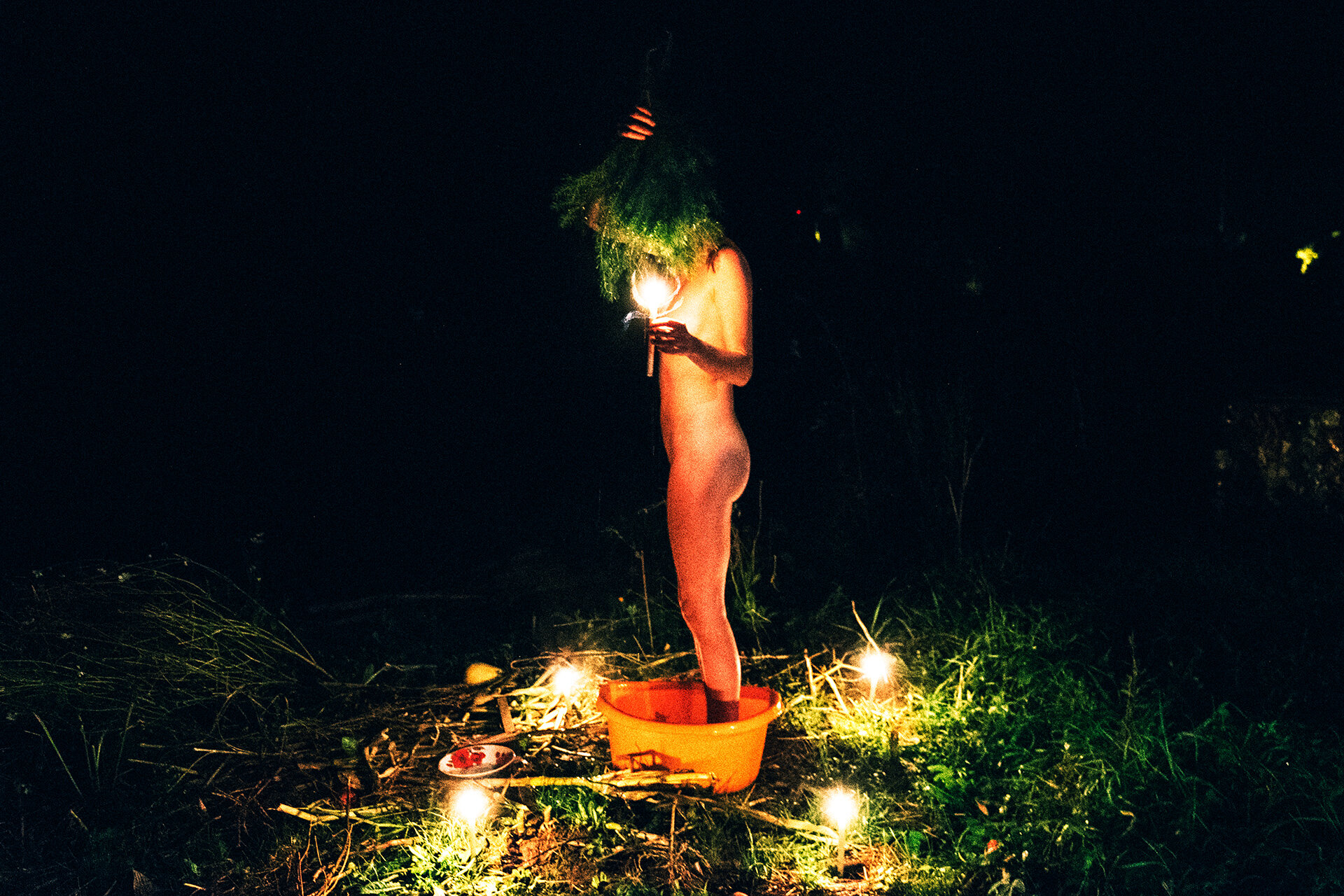
You may well have already seen Mar Lébou’s The Book of Molfars in The Re-Enchantment Issue. After publishing it, we received an unusual number of (serious) emails, asking us where one can purchase said book. The answer? If it wasn’t clear from his photo essay, Lébou says “the book is within us.”

The artist was born in Russia, and in his late 20s emigrated to Portugal. He is better known by another name and is a respected documentary photographer. His photos have appeared in National Geographic, the BBC, and The Guardian, among others, and he has worked with various NGOs. The Book of Molfars was initially published as a multimedia project by Bird in Flight. These photographs offer an intimate portrait of a community of shamans living in the Carpathian Mountains, who live with nature, not against it. We had a chat with Lébou about the making of this project.

14.jpg

Elizabeth Kim You're a documentary photographer known by another name, in a well-respected agency. Why did you decide to do this work under another name?

Mar Lébou As a documentary photographer I usually cover humanitarian and environmental issues, like climate change or child slavery. At the same time in my personal life, I have for many years been exploring the relationship between humans and the world of the Spirit. When working on Molfars project, its format didn’t fit into my “normal” photography life so I decided to publish it under my spiritual name, Mar Lébou, which I received during one mystical initiation in Senegal. Some of my colleagues know about this project and the name I work under. I am quite excited to experiment with publishing some of my works under a different name, I think it’s not an unusual practice.

EK How did you learn about the Molfars?

ML In 2018 I visited Ukraine many times and really wanted to explore the Hutsul magical traditions in the Western part of the country. That’s how I discovered molfars. I partnered up with a Ukrainian online magazine, BirdInFlight, and they sent me to the Carpathian Mountains to find the mysterious magicians. 

EK What drew you to this project? 

ML I am currently working on a big project about world shamanism and wanted to see what I could find in Ukraine. Back in 2010-2011, when I lived in Mozambique for a year, I was working on a project titled ‘The Spirit of Mozambique’ and met many shamans and traditional healers. I also underwent a spiritual initiation in the Nyau brotherhood. Those experiences really opened me up to the reality of the spiritual world. Earlier in life, I was involved in religious and spiritual life in the Eastern Orthodox tradition and in the Islamic Sufi path where I underwent several initiations as well, experiences based on belief. Meeting with the African shamans turned belief into knowledge, based on direct experience, if you understand what I mean. Since then I regularly go to Africa and continue my exploration of those traditions, many of which still remain hidden. A few years ago I’ve decided to expand this exploration and look for other world shamanic traditions. That’s how Molfars have become a part of it. 

EK Was it hard to gain access? And were you able to document everything?

ML It was and wasn’t easy at the same time. When you work on projects like this you need to understand that not everything will work under the normal rules and circumstances. Some potent and mysterious things happened during the course of shooting. For example, on a number of occasions, we tried to get into the village to see one famous molfar lady, and we weren’t able to. Every time something would happen—the car broke down, people would give us the wrong direction. It was clearly a sign for us not to disturb that lady. Also, some molfars do not want to go public, as several years ago one very famous molfar, Mykhailo Nechay, was assassinated because of his work. I had only two weeks in the region and of course, it wasn’t enough time to find and visit all of the molfars. But those we visited shared some of their knowledge with us.


EK How long has this project been in the making? 

ML Two weeks in the field and several months of home-based work. When I brought back the images from Ukraine, I realised it would not be a normal documentary-style project. It was asking for something more. The molfars wanted to speak through it themselves. That’s why the text (as well as the whole format) is quite esoteric and has many riddles and hidden messages. Those who have eyes shall find them. When I was writing the text I was receiving many ideas in my meditations and dreams—all of them are reflected in the project. I’ve also researched many old Ukrainian books on folk magic, grimoires and even underwent some shamanic ceremonies to better understand what they feel when they do it. It was quite a journey and I am happy with the result. 


EK What kinds of rituals and beliefs do molfars typically practise/hold? 

ML It varies. Some are healers or herbalists, others invoke spirits and do spells. With a few exceptions, most of them are involved in village magic and their practices are related to sowing or harvesting rituals, healing wounds, connecting with elements and natural places of power, protecting homes and people from the influence of the bad spirits, and so on. 

EK For those keen to learn more about molfars and Ukrainian shamanism, are there any books you can recommend?

ML I could recommend the classic book Shadows of Forgotten Ancestors by Ukrainian writer Mykhailo Kotsiubynsky. Another interesting read is a book printed in 1909, called Materials about Hutsul demonology, written by Antin Onischuk. I’m not sure if there is an English version, but those who read Russian or Ukrainian will enjoy it. 

EK What have you learned about yourself and the world while working on this series?

ML Well, many things. I had another confirmation that we are all connected, and not only through our physical existence. Messages from the molfars were reaching me even after I left the Carpathian mountains, when I got back to my home in Thailand. There, while working on drawings, poems and text, I received a message, telling me to experience the burial ceremony, a very ancient initiation practice that is also used for healing. The famous molfar, Nechay, did it once a year. I decided to do it on my 38th birthday for 38 minutes and asked my friends to witness it. Spending 38 minutes buried alive, with a bamboo straw in my mouth as the only connection with the outside world, was quite an experience! I had many visions and realisations while underground, which I reflected on in this project. But the best thing was reconnecting with my father, who died at the age of 38… When I left my “grave” I felt something had shifted. I am not the same person I was before.


Mar Lébou’s The Book of Molfars appeared in The Re-Enchantment Issue. You can also experience the multimedia project via Bird in Flight. Follow the artist on Instagram @marlebou.

10.jpg
15.jpg
09.jpg

All images © Mar Lébou


In conversation with Andrew Whittle

Andrew Whittle on Netflix’s The Big Flower Fight

Andrew Whittle on Netflix’s The Big Flower Fight

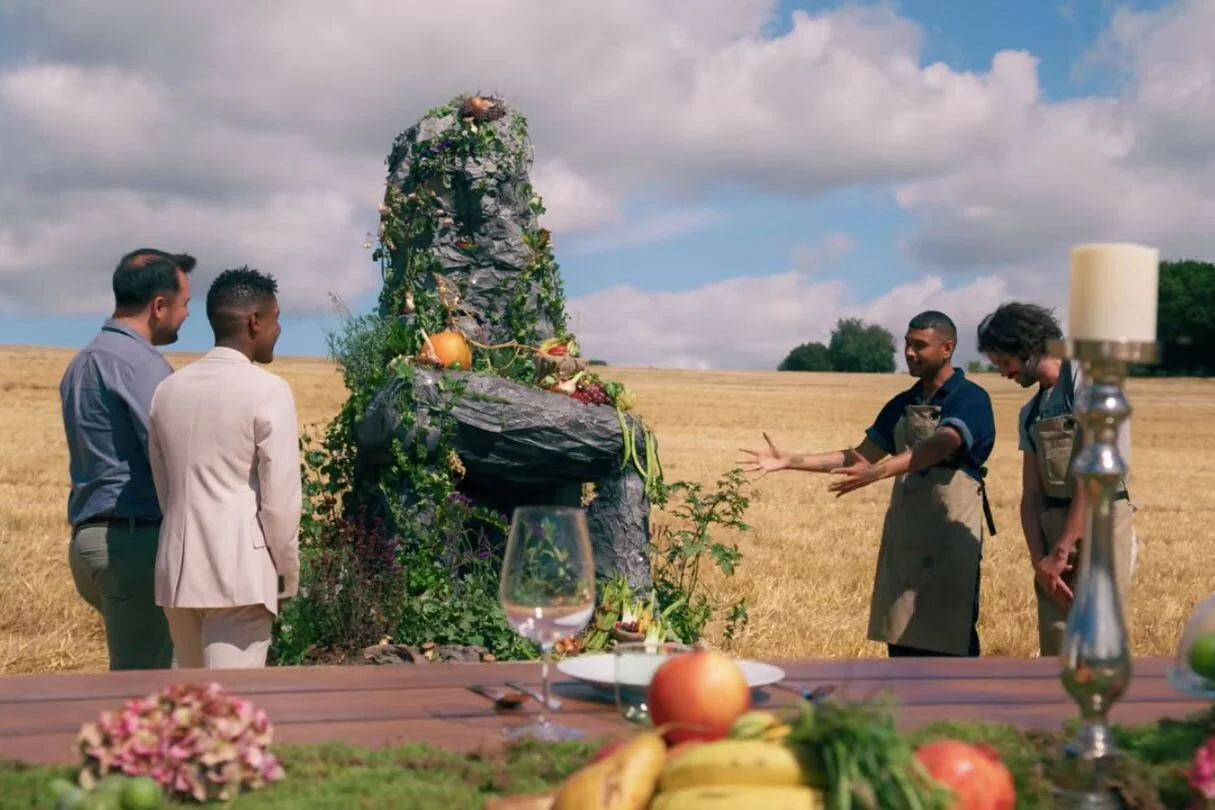
At the beginning of lockdown 2020, many of us were glued to our screens watching Netflix’s Big Flower Fight. In it, contestants were pushed to their creative limits, racing against the clock to conceive and create  enormous horticultural installations. There were giant insects and sea creatures; there were edible thrones and fairytale-esque dwellings. It has been described as the gardening world’s answer to The Great British Bake Off, but it’s wilder than that. Though perhaps less accessible than its baking counterpart, I found the large-scale floral creations an inspiration; they were created with limited time using grasses, flowers, and found things, a testament to what can be created from nothing, if we adopt a new way of thinking and seeing. Contestants Andrew Whittle and Ryan Lanji won the competition with their otherworldly structures. Neither were florists, but their artistry and craftsmanship translated well to this new medium. On seeing the fairytale cottage and Merlin’s throne, I wondered whether Andrew and Ryan were interested in the esoteric. Via his Instagram, Andrew has shared photographs of Neolithic standing stones, an interest in ley lines and folklore. I had to enquire further, and Andrew kindly agreed to have a chat about being on the show, his occult inspirations, and the final prize, work commissioned by Kew Gardens. 

Original sketch of Merlin’s throne, © Andrew Whittle

Original sketch of Merlin’s throne, © Andrew Whittle


Elizabeth Kim What was it like being in the Big Flower Fight? 


Andrew Whittle The Big Flower fight was an opportunity that came out of nowhere. Upon arrival it was clear that we were surrounded by expert horticulturalists, people that know the world of plants by name and the ecosystems they create. I have only ever had an instinctual relationship with plants; as a child I spent most of my time in the woods tending small gardens I had compiled from the wild, building dens, treehouses, and training wild roses to conceal them. 


EK That sounds like a wonderful childhood. It was often repeated during the show that you and Ryan weren’t florists; you’re artists. Was it very different working in a new medium?


AW A slight imposter’s syndrome crept in as the lack of plant knowledge became apparent. However, they became a new medium to work with; they  become textures and colours, ready to be woven together into a tapestry creating illusion. 


EK One criticism of the show was that unlike cakes on the Great British Bake off, people don’t just try their hand at making giant animals made of grass, flowers and recycled goods—but you did it and under a strict time limit. Were you thinking this big before the Big Flower Fight, and has it in any way changed what you thought you were capable of? What would you say to people who want to try their hand at gardening, or creating extravagant floral installations? 


AW The scale of the pieces were immense, and as a participant who didn’t really know what was going to be presented I couldn’t help but be excited—it’s a rare opportunity to go hard or go home and really fun. The time constraints were difficult but i developed practices that  helped during the show, I would take time out to meditate in a small garden I found around the back of the house which dissolved the chaos and allowed me to work within the time parameters we had—which were extremely tight. 

Not everybody will get the opportunity to build on this scale—they are generally show pieces. One thing I would suggest to people is to use some of the ideas within their garden, like texture and colour. The use of waste material (the Sea Horse), a wild flower meadow (the Bee), grass garden (the Boar), undulating surfaces (the T-rex). I wouldn’t be fooled by the initial impact—these sculptures aren’t built to last much more than a month. However it is possible to create sculpture from other materials that can become a part of the garden, use them to grow around, up, and on. The natural materials are the best way to do this—they create habitats for many species and have little to no impact on the environment—or use waste materials that do not biodegrade as a means of suspending them outside of the ecosystem where they create as little damage as possible. 

EK I loved Merlin's throne. The attention to detail was incredible, from the edible herbs to Merlin’s face pushing through the rock. How much time did you have to conceive it, research it, and what ideas went into it?

AW Merlin’s Throne was the passion project for me, I have worked closely with neolithic sites in England and Northern France in previous projects. These monuments function as antennae, placed on nodes on the Earths energy grid and are able to alter our perceptions. The idea of Merlin’s memory  being embodied in the stone was fun, I wanted somehow to show the memory of quartz and create an apothecary garden. The show was a playful environment and it was interesting and fun to place these ideas within that context.

EK I had a look through your Instagram posts, and there’s so much there that would interest our readers, including those Neolithic structures, stone circles and ley lines. What first made you interested in the numinous? Is much of your art inspired by these ideas? 


AW I would say that my interest in the numinous developed quite early through a fascination with mythology and much time observing nature outdoors and feeling a part of it. When I was young I spent many nights floating in a black abyss with no body; I was looking for something. It developed considerably whilst finishing my degree; I was reducing  photography to its most minimal. This led to a lot of research into the atheistic world of science (nothingness) which didn’t suffice, so instead I turned to alchemical and ancient texts that drew me towards a more intrinsic way of seeing and feeling my experience here. Around this time I also had a bout of seeing UFOs—these experiences took some reconfiguring of thought. As my perceptions changed, the ability to see reality and experience as something that can be manipulated grew, and that I understood as  the source of magic. 

Much of my work is inspired by The Great Work. Alchemy and reduction/purification to me are intrinsic to the photographic work that I do, with light being the main medium. I think any exposure to these ideas can begin a transformation. I believe there is a universally felt absence derived from a detachment with nature. A regressive future could lead to a reconnection and further symbiosis with the planet. I do not deny the potential of science and forward thinking to help us achieve this—anything we learn from history is manipulated by all the events that occurred between then and now, therefore our re-application of it would not be exact; I mean regressive perhaps in that we should shed a lot of the syntactic way of thinking we have now in terms of how we treat the planet. 


EK We resonate with that feeling of disconnection from the natural world, which leads me to The Whale you created out of beach waste, repurposed for longevity. Can you tell us more about your Kew Gardens commission?

AW The final prizeThe Whale at Kewwas a great project and opportunity. Beach Guardians are a charity in Cornwall who provided all the waste for the sea episode. They regularly clean their beaches of both large and minuscule plastics that are slowly becoming our ocean. The Seahorse was my favourite during the Big Flower Fight, and so I immediately got in touch to work with them again at Kew. As with many large pieces, when they are finished with they are often scrapped. So after Kew I got to work in securing the incredible structure so that we could gift it to Beach Guardians where it will be installed permanently in their communal meadow. This second project is where the whole experience started to make sense. We used ghost gear to weave the entire structure, to bind the plastic to the whale creating something entirely new and unrecognisable to the original medium.

Grace Emily Manning (my partner on this venture) and I spent around 250 hours weaving the whale with help from volunteers, and during the evening we embedded ourselves in the Cornish coast. The Blow Hole at Trevone, and many caves that we imagined as the belly of the whale, became spaces of metamorphosis where we began to un-do some of the damage. Throughout this whole process we aimed to cleanse the materials and our societal  relationship with the planet. We conducted small rituals based around the area at night with the weaving of the whale being the biggest. We were apple bobbing on the Cliffs under a full moon at Alentide (these apples came back to us almost a week later). Seeking faces in the rocks and following quartz lines we connected to the area. The project is being developed into a short film that we will show in 2021.

I think the main criticism of the sculptures being unattainable is true, which was the main reason (other than sustainability issues) why I felt that the Whale must be gifted to others. In every monument you imbue spirit and if unwitnessed the sentiment can die alongside it. The longevity of standing stones is a testament to this; though many are overgrown, disheveled and are functioning at only a fraction of their potential, the purpose is there even if only to inspire. 

Photo: Netflix

Photo: Netflix

Screenshot 2020-05-23 at 13.15.02.jpg
Screenshot 2020-05-21 at 23.10.36.jpg
AndrewWhittleStudioGhostGear.jpg


Andrew and Grace have set up a Patreon page where you can subscribe to fund the short film and follow its progress.

In conversation with Afia Atakora

Afia Atakora was born in the UK and raised in New Jersey; she is author of debut novel, Conjure Women. Her fiction has been nominated for a Pushcart Prize and she was a finalist for the 2010 Hurston/Wright Award for college writers. Set around the time of the America Civil War, Conjure Women follows the journey of midwife, Rue, as she navigates growing suspicion from the village community when a mysterious illness descends following the birth of an apparently unusual child that Rue feels compelled to protect. The narrative deftly weaves pre and post war narrative time-line with themes of womanhood, friendship and witchcraft. I spoke with Afia via email about folk magic, womanhood, and identity.

Photo: © Edwin Tse

Photo: © Edwin Tse

Yasmina Floyer What inspired you to write Conjure Women?

Afia Atakora I’ve always been drawn to the enduring wisdom of folklore and folk magic. So many of the stories and practices that are passed down through generations are about preserving culture and imparting a self-sufficient means of survival. Particularly in cultures displaced by slavery or strife, the fact that the legacy of magic endures is deeply powerful. The determination to pass down these histories so often falls to women, so it felt natural to begin to explore the midwife, a fixture who appears in so many cultures, and begin to render her as more than the old healing witch in the woods. What does she look like young? How did she learn her role and how does she feel about it? I began with all these questions and slowly Rue began to form, to answer them.

YF The story unfolds around the time of Civil War, why were you drawn to write about that period in history?

AA When I began studying this time period, I had no intention of writing a novel about it. The research was for myself. As a Black woman living in America, I felt that I had a very limited understanding of the history of slavery and emancipation, particularly in the years just after the Civil War. We get this broad-strokes overview, “the slaves were freed and all was well.” When it came time to explore my archetypical “folk healer” where better to place her wisdom and skills than in the years just after the Civil War, when so many deep hurts needed healing?

YF What sort of research did you do?

AA A huge resource were the interviews conducted by the Works Progress Administration, a US government agency, who in the 1930s collected the memories of former slaves. Much of these histories are anecdotal, but they represent rich shared memories of the experience of enslavement. From these I collected little snippets of familial practices: lists of herbs, beliefs and colloquial remedies. I was fascinated by the personal practices that echoed each other across the vast US South and across time. Similarly, I was influenced by folk practices that still exist today, particularly those that are practiced in West Africa and are antecedents for other diasporic practices. I explored my own family history and traditions and wrote about those too.

YF Were there also folktales from your childhood that fed into the creation of CW?

AA My parents are immigrants from Ghana, but I was born in the UK and raised in the US. I grew up with their stories from “back home,” chief among these were the tales of Anansi the trickster. As I grew up and began to try to define my own identity in the US, I found the Brer Rabbit stories. It was sort of a revelatory experience to rediscover these trickster tales in a completely different setting and yet still wholly intact from the bedtimes stories that migrated with my parents. I wanted the history of memory within Conjure Women to mirror the experience I had in defining and discovering myself, as well as the enduring spirit of Black identity.

YF Were any characters based on people from your life?

AA None of the characters were fully based on real people, however I drew inspiration from my own experiences to shape the relationships in the story, especially between Rue and her mother Miss May Belle. My own mother worked as a nurse and home health aide while I was growing up and I often observed her interactions with her patients, the way that all children do, trying to understand the world and their eventual place in it. Similarly, the character of Ma Doe, who is a symbol of the long memory of Rue’s community, is named for my grandmother, who passed down so much of her matriarchal wisdom.

YF Our protagonist Rue makes really difficult decisions in the novel, choosing to do awful things for what she believes to be the right reasons. Do you see Rue as a heroine or villain?

AA I decided very early on that I did not want there to be any clear heroes or villains in this story. I was determined to explore slavery in particular from a complex psychological stand point. What deep wounds might enslaved people carry with them? In what ways do they go about healing them or visiting wounds upon others as a means of survival? How has the violence of slavery been perpetuated throughout time, in complex insidious ways, in ways we might not even immediately recognize? In the course of the novel Rue makes a lot of hard decisions, sometimes the wrong ones, but ultimately, I believe her story is one of redemption and self-discovery.

YF The townspeople begin to call Rue a witch. Do you identify her as such?

AA I very intentionally chose the term “witch” for the accusation thrown against Rue. There’s so much historical connotation to the word, so much of it negative and so much of it female. Rue and her mother possess mysterious skills throughout the novel, but Rue only becomes a “witch” in the eyes of the town people after they feel that she has failed them. The echo of that insult is not only that you are a strange woman but that you are a solitary one and women who live outside of the boundaries of society ought to be castigated for it. She becomes a dangerous witch in the eyes of the community particularly when she uses her powers to her own advantage, again an insinuation that a woman must never be concerned with her own needs or ambitions, but give of herself endlessly. Much of the story is about Rue taking ownership of this term, “witch”, of becoming not only proud of her abilities but proud to be a brave, independent spirit.

YF I love how you depict the women in the book as young girls navigating the transition into women. Why are you drawn to this period of womanhood?

AA There are many, many themes in Conjure Women but for me, the coming-of-age of young women is one that is paramount to the telling. While Rue’s experiences growing up, enslaved and then freed, are specific to this era, her relationship with girlhood is timeless. I was fascinated by the way that young girls emulate, learn from, and sometimes reject their mothers. I was drawn as well to bonds of friendship that women form with one another and the ways in which that changes as they grow up, especially within the constraints of a society which has clearly defined roles for what it means to be a woman of a particular race.

YF The novel explores identity and how identities shift depending on time and place, gender and race. What do you hope the reader will take away from the novel?

AA I hope that the novel portrays historical characters and enslaved persons as full-bodied people, not just caricatures, or object lessons, or bullet points in history. They lived full unique lives, sometimes flawed, sometimes painful, sometimes hopeful. The institution of slavery has cast a long shadow not only in America, that shadow remains and needs reckoning with. Despite the pain and the darkness, we owe it to these people to explore their histories and legacies. We owe it to ourselves, too.

In conversation with Edward Parnell

unnamed (1).jpg

Edward Parnell is the author of The Listeners, and more recently Ghostland, a memoir-cum-literary tour of Britain’s ghost tales and loss. The book was shortlisted for the PEN Ackerley Prize 2020 for memoir and biography. Its hauntings are linked with landscape, memory and an awareness of the passage of time. I spoke with Edward via email ahead of the paperback release of Ghostland

unnamed.jpg

Elizabeth Kim What compelled you to write Ghostland and what did you initially have in mind for it? 

Edward Parnell The book came out of a meeting with my editor Tom at HarperCollins, who’d seen a blog post I’d written about the village in Suffolk where M. R. James grew up. We met and bonded over a love of ghost stories and slightly pulpy ‘70s horror movies and I went away wondering whether I could write a book about the love I’d harboured for ghost stories since being a young boy. I soon realised that were I to engage on such a project I’d only want to do it if I could bring something unique to the subject. And I realised how entwined many of the places that I would want to visit – places that were in some way linked to various stories, authors or films – were with my own rather haunted family history. And so I went away and came up with a proposal for a book that, as well as examining some of my favourite authors, would also be an exploration of my own lost family. 

EK Is that blog post still available, somewhere?

EP No, I took down that blog post when I began writing the book as there was some material in there that I wanted to use! I kept a few photos on my website.

EK Why do you think people in Britain and Ireland are so good at writing ghost stories?

EP All that pressing history, I think. Almost everywhere you go there are reminders in place names or old architecture of the people who have been there before you. Only the other day I was driving back to my house from the North Norfolk coast and passed a small country drove I’d not previously noticed called Gallowhill Lane, which put me straight in mind of M. R. James’s ‘A View from a Hill’…

EK You often refer back to M. R. James. Why do you think was James so influential, and which of his stories would you recommend to new readers?

EP I think James is so influential because his stories are simply so good – so full of atmosphere, eeriness and playfulness. He wasn’t that prolific (there are around 30-odd stories that were published in his lifetime) and as a result the consistency remains high throughout. I’d definitely try and read them chronologically in the order that they were published, though, as I do think there’s a bit of a drop off in the later stories – though actually the reason that some of those are perhaps a bit more unsatisfying is because they’re structurally more complicated and harder to try and decode. It’s hard for me to pick out a favourite as that seems to fluctuate depending on my mood, but ‘Oh, Whistle, and I’ll Come to You, My Lad’, ‘Lost Hearts’, ‘The Mezzotint’ and ‘Count Magnus’ – all from his first published collection, Ghost Stories of an Antiquary, are a good place to begin. 

EK Aside from M. R. James, which ghost stories have frightened you or spoke to you the most?

EP I’d like to think I’m not that easily spooked, but the one book that did unsettle me when I was writing Ghostland was Shirley Jackson’s novel The Haunting of Hill House. I remember reading it on my own at home at night and definitely feeling a little nervous of killing the light and trying to go to sleep. Other favourites include Algernon Blackwood’s sublime ‘The Willows’, William Hope Hodgson’s weirdly wonderful novel The House on the Borderland, Rudyard Kipling’s heartbreaking ‘They’, and E. F. Benson’s ‘Pirates’. And if we’re talking TV and film then there would be another huge list!

EK I love Shirley Jackson! Now you mention near the beginning of Ghostland that most ghost stories happen in the past. There is a narrow division between nostalgia, sadness, and the uncanny in most. Your own tour of Britain via the ghost stories written about it is interwoven with a memoir of loss. Is there some truth to these weird tales? Are there some ghosts that don't move on?

EP I certainly think that there’s a truth in the subtext of lots of these tales, the best of which deal with huge themes like grief, loss and mortality. And life and the world can obviously be weird and unsettling – as these strange present days show us – with things happening that we can’t easily make sense of. A good ghost story can certainly help to explore this. 

As to ghosts that don’t move on, I think that most ‘real’ hauntings intrinsically contain place-bound phantoms. And that’s something that I feel a bit of myself, as I know that in Ghostland I was trying to stare back into my own past. Yet, I wouldn’t want to stop – to not be able to look back on everything that’s happened to me, even though doing so is sometimes painful; I think we walk a tightrope between acknowledging our histories and being beholden to them, but hopefully I’ve got the balance about right. 

EK From your book and beyond, have you ever had an experience or encounter you couldn’t explain?

EP I talk about a handful in Ghostland – one odd occurrence that took place in a room I subsequently found has a long and documented history of strange occurrences, and another in the house I grew up in, when I returned to it as a student. Generally though, I’d hazard that if as people we have different levels of weird-detecting ‘radars’ then mine is set at a very low level… Because I can seem to walk around places and not get spooked by things, whereas I have a friend who could be in that same room and claim to be picking up odd vibes that have completely passed me by.

EK How do you explain such unexplainable experiences?

EP I definitely always try to rationalise any odd experiences that I’ve been privy to – so for instance the ‘phantom door bell’ that periodically goes off in my house and plays a ringtone that isn’t selected is something I’d put down to being some kind of radio interference. I have no scientific basis for this, but it seems more likely than some esoteric spirit trying to contact me! I fully accept, however, that there are plenty of good documented examples of odd things that are difficult to rationally explain. So, like M. R. James, I take the view that “I am prepared to consider evidence and accept it if it satisfies me.”

EK So open-minded with a healthy dose of scepticism.


EP I would say open-minded with a health dose of scepticism neatly sums up my view of strange occurences. Though a bit like Fox Mulder, a part of me “wants to believe…”

EK New nature writing is increasingly veering into the territory of the numinous. I’m thinking about writers like Robert MacFarlane and Helen MacDonald. What role do you think this new sort of “emotional ecology” might have in repairing our relationship with the natural world, and in order to repair this relationship, do you think it’s important we also reconnect with the supernatural world?

EP I think in order to have even a chance of repairing our fractured planet we do need a lot more people to feel a strong connection to it, and then to make choices and act in ways that start to make a tangible difference. I don’t think that’s going to be easy to achieve, but if part of that process also means that people have to engage with the layers of history, superstition and human experience that are intertwined with places – then that surely can’t hurt. 


In conversation with Kaitlynn Copithorne

Sanctae Hildegardis

Sanctae Hildegardis

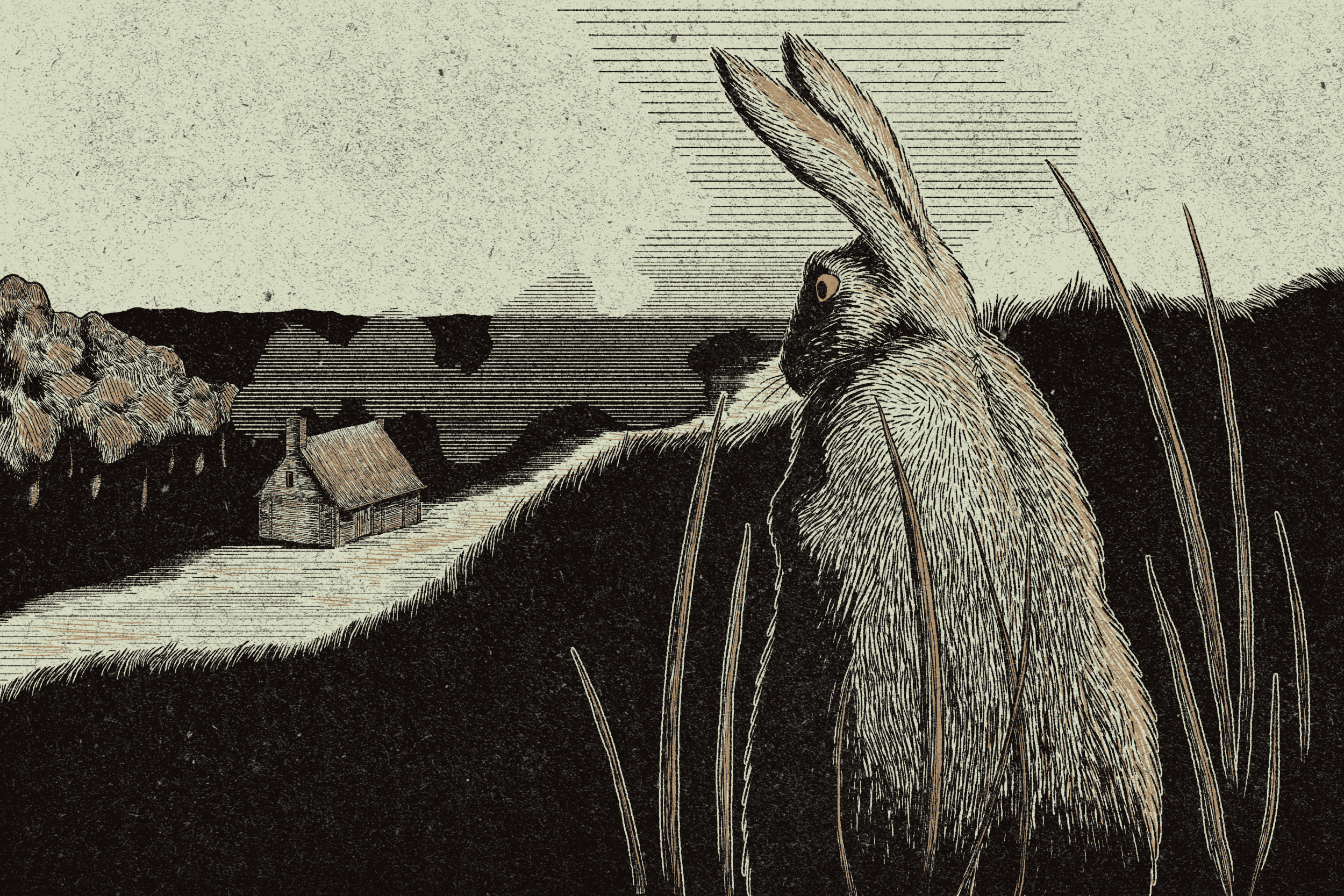
Kaitlynn Copithorne is a Calagary, Canada-based illustrator and a regular contributor to Cunning Folk. We instantly fell in love with her distinctive aesthetic and her depictions of animals and folklore. You can see her work throughout our website, and illustrating Zoe Gilbert’s short story The Wild Hunt in our first print issue. We have plenty of exciting things planned in future together, and Kaitlynn is definitely one to watch. Normally Kaitlynn’s images speak for her, but we had a brief chat with her about her inspirations.

Cunning Folk Tell us about your own practice, both creative and magical.

Kaitlynn Copithorne I am an illustrator and visual artist working in digital, printmaking, and  painting mediums. I like my work to tell stories. Magically my practice would probably fall under the “traditional witchcraft” definition, and since I deal mainly with land wights and the energy in the landscape, depends heavily on where I am practicing.

CF How do you find ideas? Who or what inspires you?

KC Most of my inspiration comes from nature, folklore, and mythology, particularly creation and etiological myths. I grew up quite isolated on a ranch in rural Canada and spent a lot of time by myself in the forests and fields, and so I think the natural world just became my primary knowledge base for understanding the world. I’m a big collector of folklore as well and that is definitely where my mind tends to go first when starting a new project.

CF What is your dream commission?

KC Right now I think my dream commission would be an oracle or tarot deck. I am very interested in the challenge of creating a visual language for a body of work that large while keeping it all cohesive. 


CF
What initially drew you to folklore and witchcraft?

KC Initially I was drawn to it through movies, especially The Craft. I was definitely an outsider and I saw characters I identified with empowering themselves through witchcraft and wanted that for myself. As I learned more about cunning people and witch lore I realized that their practices were actually not that different from my own “superstitions” as I called them that I developed growing up on the ranch.

CF You have done quite a lot for cunning folk. What about this project appealed to you?

KC I was drawn to Cunning Folk because it combined so many of my interests (mythology, folklore, witchcraft, nature) in one platform. I’m always looking for witchcraft and folklore themed publications and zines, and Cunning Folk struck me as contemporary and less academic than other publications I subscribe to, and I mean that in a good way. It handles these subjects on a very personal level, and I find it very fulfilling to myself creatively and magically to read about other people’s personal practices.

CF Pertinent to this current issue, do you think we are going through a period of re-enchantment?

KC Definitely. I think enchantment works as a cycle, and we are currently at the point where widespread dis-enchantment begins to breed re-enchantment on a collective level. Speaking specifically from a North American perspective, we are realizing that the colonial systems in place supposedly to keep us safe, healthy, and fulfilled do not in fact do any of those things very well, if at all, for a vast majority of us. Even more distressing is the dawning realization that this system isn’t failing us because it’s broken, it’s functioning exactly as it was designed to, and does not care about anyone falling through its cracks. And so, like cunning folk of the past, when the institutions won’t empower us, we seek to empower ourselves. To me, the fact that we keep circling back to magic when everything else has let us down speaks to how deeply embedded it is in us. When our power has been taken away from us we inevitably turn back to ourselves to replenish it, and there we find magic waiting for us.

Illustration spreads from in-progress project The Moon Being Full.

Illustration spreads from in-progress project The Moon Being Full.

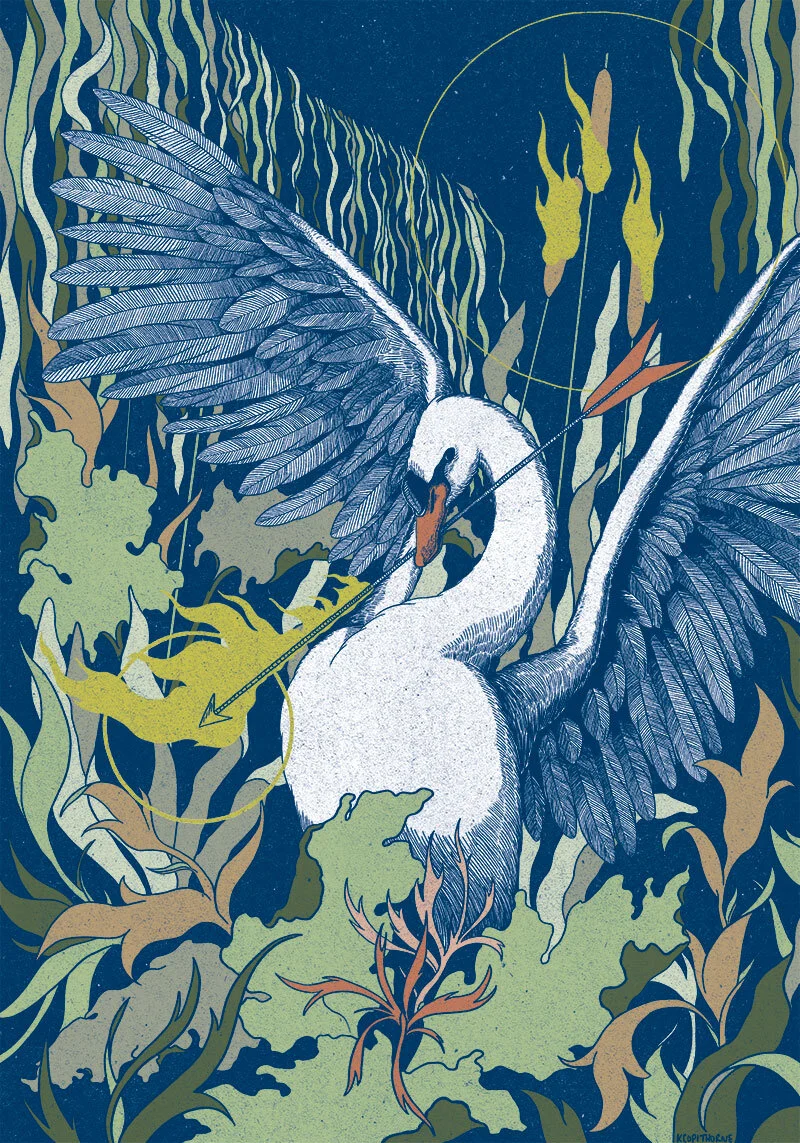
Swan Brings the Holy FireCurrently available in collection at Glo’Art Centre, Belgium.

Swan Brings the Holy Fire

Currently available in collection at Glo’Art Centre, Belgium.

Block Heater Music Festival 2020

Block Heater Music Festival 2020

All images © Kaitlynn Copithorne

In conversation with Jenny Hval

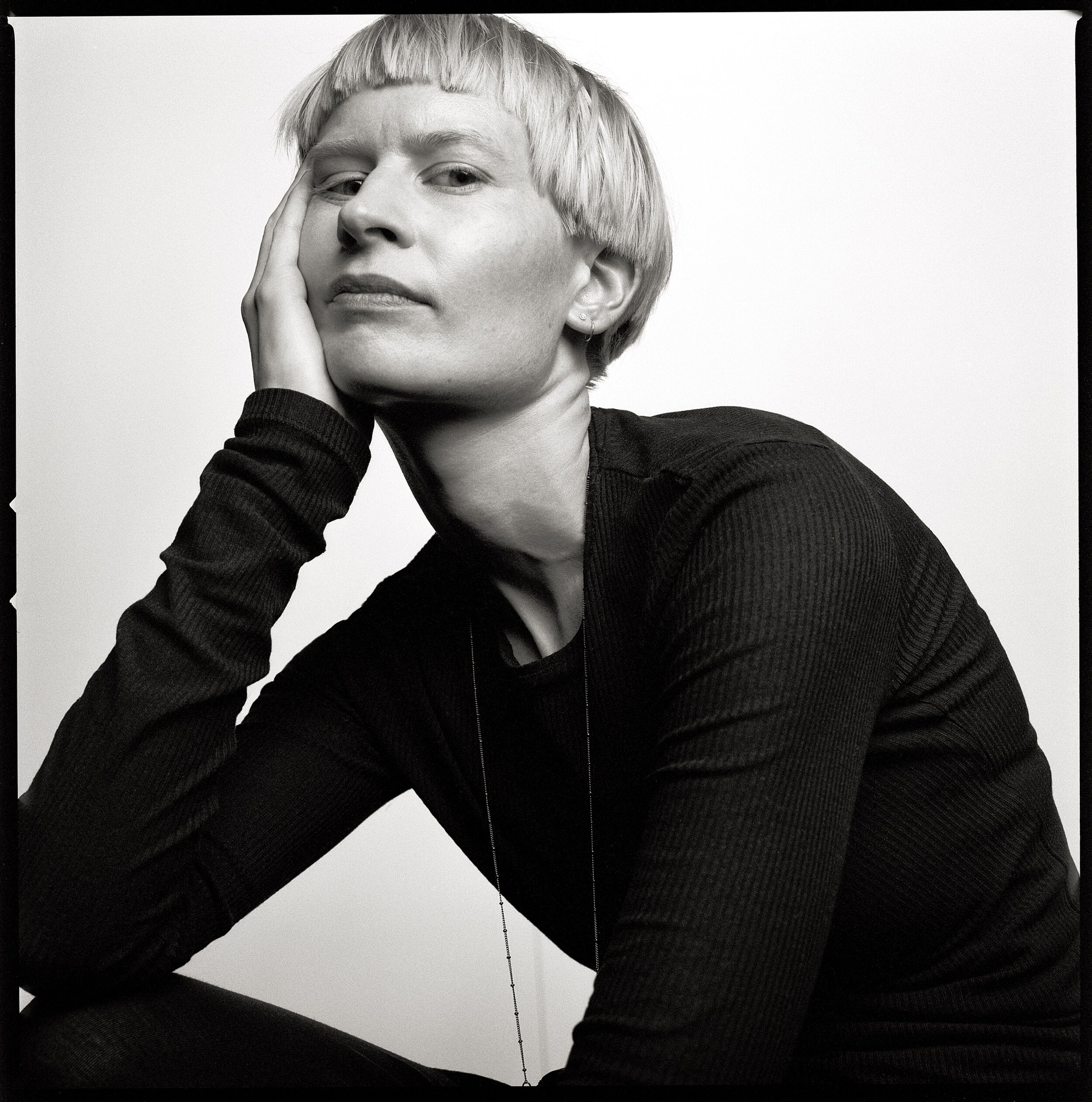
Jenny Hval is a Norwegian musician, singer-songwriter, producer, and novelist whose work is multidisciplinary and transgressive. She made her writing debut with the critically acclaimed novel Perlebryggeriet in 2009 (published in English as Paradise Rot in 2018). Her latest novel, Girls Against God was published in Norwegian in 2018, and has just been published in English by Verso (translated by Marjam Idriss). Girls Against God is a meditation on magic, art and writing, via the lenses of black metal, heresy, technology and the occult. I spoke with Jenny over Zoom shortly before the book’s release.

Photograph © Baard Henriksen

Photograph © Baard Henriksen

Maria Blyth The novel really resonates with me, Jenny, in part because like the protagonist I too was a provincial goth growing up in the far North. Though I’m from the Shetland Islands, I feel like I’m almost Norwegian—I’m familiar with the landscape, the Shetland dialect is very Nordic, and there are so many cultural similarities. The book really made me think about those provincial subcultures—goth, black metal, and so on. This made me wonder whether, growing up, were you a provincial goth too?

Jenny Hval I’ve never been to the Shetland Islands, but I’ve always wanted to go! I was really into horses in my youth, and that connection with Norway was really intriguing—this sort of in-between place. This book is very Norwegian. I think I tried to be a goth for a while, though not as much as the character in the book. I was in a goth band and I was trying out this goth thing. What connected with me was the opposition to a lot of things, but then I was also disappointed by how apolitical a lot of it was, or at least not political in the way I was leaning. So I think I ended up being in the goth group but also being more of a misfit. But that’s also okay; the clothes don’t fit, the corset doesn’t fit, my taste in literature didn’t fit with the ideal at the time. I never got into Lovecraft, for example. I think I was a bit snobbish. I wanted to go for more modernist-type literature; I was quite set on what I wanted to read and enjoy. One of the major traits of deciding what kind of identity you’d like to reach for, and how to get there—mine was literature and maybe music. So I was part of the goth group, but I didn’t feel at home there. And maybe others didn’t either. Maybe that’s a major part of being young—not fitting in, feeling like you fit in nowhere, that no-one understands you. 

MB That’s so true—even when you find your people, your subculture, that feeling of being an isolated individual doesn’t really go away.

JH Yeah. Subculture is often not as cultish as it seems—most societies and subcultures and congregations have more variation than you think when you’re young. You think that everyone’s part of the same flock of sheep, but as soon as you get to know people, it’s not the case because people are so different. So, I felt out of place, but quite at home. I didn’t enjoy the dresses but luckily there were fake leather trousers!

MB So, you were kind of into the goth scene—was this when you became interested in magic and the occult, or with this novel are you coming at it anew? I can see occult threads and themes throughout your writing and music.

JH Well I think I discovered it after doing it. I wasn’t very into these things beyond reading about Wicca and Pagan rituals on the early internet in the 90s. I was fascinated by it but not really studying it—it was pure fascination for me, but there was no such thing in my region, and perhaps not in Norway at all, at least that I could see. So it felt very far away from me. When I started doing my own music in my mid-20s, I guess that after a while I realised how interested I was in the ritual of performing. I think for many years I was more interested in the performing arts—performance art in particular—because of this closer connection with ritual than I could find, even in subcultural pop music. I realised I can do elements of this on stage, I can use the space visually, I can look at the space of the stage differently, even if I’m performing music. I can look at music as an incantation, as a spell, as something that is brought to life with its own kind of magic. That’s become more and more important in my work. I think that it’s been the motivation all along, but I hadn’t been able to see that until I started working towards creating this book. So, over the last six or seven years I’ve realised more and more that music does have something to do with magic and ritual. Even if my work is not coming purely from that subcultural longing any more. 

MB I really love this idea of the band as a coven casting spells together. One thing I like about the spells in the novel is how many bodily fluids are involved. This is something I find really interesting about all of your work—there’s something really tied up around physicality, the body, nature, “filth”, in a certain meaning of the word. Of course, bodily fluids feature throughout the history of magic and spellcasting—they are such an integral part of magical practice. Why do you think this is?

JH My entry points to magic are art and music. Music, because that’s my stage, it’s my ritual output, which is much more visceral a process than writing is. And I write a lot about this in the book—about how you write the spell and it can be performed, but it’s sort of in an in-between place of not existing yet, not being put into words yet, or not being in the body yet—like you’re creating future bodily fluids. To me, experiencing singing is what makes me write a lot about fluids and the body. I’m not necessarily the kind of artist you’d call a visceral artist—I don’t spit on stage or come across as an extrovert. I’m not a confrontational body-oriented artist. I’m really much more of a shy person. But I find that bodily fluids and singing come out of the same process—they both come out of your body and are not of your body at the same time. So they’re kind of in-between life and death. They’re in between the temporal and infinity—they don’t belong to you. Which is problematic because as soon as you’ve said something it doesn’t belong to you anymore. Which is beautiful, but it’s also abject. I remember back in my early band days, when I’d hear my voice in a tape recording, I’d have this very abject reaction; kind of like seeing your own pee, or getting your period. This experience, for me, was a very extreme experience. I think about this when I record because my intentional sound is always different to what I listen back to. It’s this strange opportunity to have this interaction with yourself that’s both inside and outside. So it’s partly this connection with singing, but also having studied a tonne of feminist literature, and the history of performance art since the 60s. To me, when I discovered all that, I discovered “oh, art is real”. There is something there that belongs to me, belongs to everyone. And it’s not coming from a place I can’t access or understand—it’s lived. 

MB On the topic of things outside the body, sometimes inside it, technology comes up in Girls Against God a lot. What do you think the role of technology is in magic, and vice versa?

JH I’m really curious about what your thoughts are! I felt like when I was writing about the visceral internet, or connective technological tissue, I was finally writing science fiction, which has been a dream for me to do. I felt like I got to this point where I could finally go off in that direction. For me, I write myself to starting points for going out of a more realistic type of narrative voice, then onto what I am the most interested in, which is getting to those places where I can write that film script, write the apocalypse, write about this intersection between magic and technology. For a while I thought I actually want to write an entire book that is about a parallel society in which everything is the same as the real world except the internet is visceral. That would be crazy! Now, because of the virus, I’m like “don’t go there, don’t do that”. I guess the internet is philosophically very fascinating, and there was a time when it was full of opportunity. I remember in the 90s when it was a hidden, subcultural place that felt like being underground. Not to be super nostalgic—that’s not a very productive story—but the book goes to this place where there’s a place for a different type of body, and a different type of experience of the body, and the connection with other people. I guess for me that’s the magical part—feelings of belonging and community, things that we’re really longing for at this time. Closeness, the feeling of affinity, the feeling of an unspeakable or inexplicable intimacy. Maybe beyond words, but maybe not beyond code. 

MB And maybe not beyond magic. If you could define magic, in a few sentences, without really thinking about it, how would you do it?

JH I’ve already thought about it! Transformation. One word, but many syllables.

MB And what does transformation mean to you?

JH It’s the combination of space and time.

MB Talking of words, and the meaning of words—swearing, blasphemy, and profanity come up in the novel a lot. Why is blasphemy so thrilling to us—why does it have this real allure, this magical quality?

JH Well maybe I could’ve said blasphemy is magic. It feels like a strong experience because it’s an opposition, and being in opposition makes you realise that you exist in opposition to something. Blasphemy to me is also being part of the huge opposition to institutions, which might be stupid, as we’re also part of institutions—this book is published through institutions, and I perform because of institutions. I went to university, I learned about magic, all because of institutions. The feeling of being in opposition is also the feeling of being part of forces that are almost in opposition to humanity, or to its structures and hierarchies, and being part of nature. For me, swearing is like being the wind in the trees.

MB That’s such a graceful way of framing it. In the same vein, it would be good to talk about hate—for the protagonist hate is such a fuel. Is hate a fuel for your work?

JH For this work in particular, definitely. For this book, obviously it’s a huge motivation, for the protagonist it’s the reason to write, and because of that, perhaps for me as a writer. And I do think that I’ve needed to feel rage to begin to write, many times. I do think that sometimes I’ve needed this type of energy, oppositional energy, in order to say anything at all. But it’s not always my motivation. I think that it appears a lot, sometimes more humorous, sometimes more sarcastic or energetic, but also sometimes I feel very different energies—I think it comes in waves. Sometimes the need to hate, and sometimes the need to pick apart the emotional and go into an approach that is much more meditative. I’m able to get there also by using the hate energy. I don’t get to wellness by wellness. It’s never that easy. I kind of felt, after I finished this book, that I was more at peace with Christianity, which came as a surprise.

MB Well that’s transformation, and as you said, magic is transformation.

JH And writing is magic.


In conversation with Renee Sills

Renee.jpg

Renee Sills is an astrologer, somatic movement educator, artist, and the host of the Embodied Astrology podcast. Through her work, she seeks to articulate and centre the embodied experience. For Renee, astrology is inherently embodied. Based in Portland, Oregon, she is a second generation astrologer and her work is deeply influenced by that of Melanie Reinhart, Liz Greene, Alan Oken, Eric Francis, Dane Rudhyar, and Demetra George. Though Renee has primarily studied Tropical, Psychological, and Western Medical Astrology, her work is also informed by Sidereal Astrology and a multitude of other cultural cosmologies.

Maria Blyth How did your astrology journey begin, Renee?

Renee Sills My mother got into astrology when she was in her 20s. She and her best friend (who is my godmother and now my close friend) studied the correlation of plants and astrology for a herbalism business they started, then later she became a massage therapist and learned some Medical Astrology to help her work with bodies, then later in her life she started to work as a counselor and used astrology with her clients. Since it was something she was actively learning and researching throughout my life, I picked a lot up from her (and her synthesis of astrology with health, healing, and psychology) simply by sharing an environment. She would always explain me to myself through astrology and when, at 13, I wanted to drop out of school and do my own thing, she saw that my chart supported that and so she used my chart to help me figure out how to self-direct an education.

My mother died when I was 17 and I inherited her library of astrology books which I then began to read obsessively. I think that since I’d grown up with it as a common language, the concepts and methods felt super intuitive and were very easy for me to grasp when I started to study it on my own. I started reading charts of my friends in my mid 20s and then started the Embodied Astrology podcast a few years after that. It’s only been 5-6 years or so now that I’ve read charts for clients professionally, but about 20 years that I’ve been committed to the study. I’m always learning, and I learn from everything - books, podcasts, classes, talking with other astro-nerds, my own chart, and observing astrology daily. I’ve had two short-term mentors – Heidi Rose Robbins and Carol Ferris. I learn a ton from my clients and reading charts all the time. I learn a ton from teaching!

MB What do you consider unique about your personal approach to astrology?

RS I think that my synthesis of astrology, somatics, contemporary art, and politics is pretty unique. I was born in 1983 when Jupiter and Uranus were conjunct in Sagittarius. I’ve noticed that my generation is full of people who synthesize, combine, and work in innovative intersections of various streams of esoteric mysticism and praxis. I haven’t (yet) met any other astrologers that share my particular intersections.

I’ve been a dancer and a mover all my life and have studied somatic methods since I dropped out of school at 13. A lot of my somatic study has been focused on embryonic, fetal, and systems development and movement repatterning. This awareness blends naturally with astro for me since so much of astrology helps us to see into a person’s psycho-energetic patterning. Working with embodiment and astrology as a combined practice allows me to work directly with people’s psycho-energetics through guided felt-sense awareness and breath and movement practices. 

I also have two degrees in contemporary art - a BFA in Intermedia and Cyber Art (a dated term by now!) and an MFA in Social Practice. I think that living and surviving is inherently creative and I’ve found that I’m significantly happier when I think of my life as an art practice (jobs, relationships, all of it). I try to bring artistic methods into embodied astrology through using sensory scores, textural descriptions, imagination games and visualisations, and always, always promoting creative perspectives and agency in my clients, students, and listeners. 

Finally, I am a very political person. I think embodiment is inherently political and astrology is a very interesting lens to view politics through. I identify as a progressive and an anti-capitalist, anti-racist, abolitionist. In everything I offer – whether to a large audience through the podcast, or in a 1-1 session – I am always orienting towards the political. It’s not always didactic, but it is always political for me. I want to support people in listening to their hearts and intuitions rather than authority figures, in untangling themselves from the destructive, dehumanizing mind-states of capitalism and colonist white supremacy, and taking a critical approach to deconstructing the formulaic expectations colonized society lays out for us in terms of what our values “should be”, and how we “should” work/labour, relate, love, live. 

MB What do you believe is the relationship between astrology and divination, or fortune telling?

RS I think astrology is a very useful tool for divination. In my experience as a sensate intuitive, looking at a person’s chart really helps to open up my intuitive channels and direct my attention. I am not really a fan of fortune telling or prediction. I do think that we can use astrology to see into and articulate someone’s past or to describe the idiosyncratic nature of a person’s inner experiences. I think we can also effectively use it to describe future possibilities, upcoming challenges and opportunities, or to give perspective on timing. But, I believe deeply in free will and I don’t personally think it’s useful or possible to tell someone exactly what will happen in their future and to trust that that information won’t create its own magnetic attraction or cause and effect. 

Astrology allows for a very nuanced approach to divination and it can look at a wide range of information as well as things that are extremely specific. In this way I think astrology is special because it can be so acutely directed. I do think it’s important to cultivate one’s intuition though, because otherwise astrology will just be methodical and prescriptive and fall flat. Because it is so specific, it is possible to use astro quite precisely to name and describe elements of a person’s life but, without intuition I don’t think we can really connect with the needs of their soul, which will direct our attention in more non-linear ways. At this point for me, reading an astrology chart feels like channeling. I don’t spend a lot of time calculating degrees or concerning myself with what others have said the meaning of something is. I just let the symbols speak to and through me. 

MB For readers interested in learning about astrology, where would you recommend they begin?

RS I think we always learn best when we’re excited about what we’re learning. I would say to start with media and teachings that feel the easiest to absorb and integrate. Not everyone can pay attention to books for a long time, but some people love to read. There are such great podcasts and online classes now, and so many astrologers who offer mentorship. Also, there are so many different kinds of astrology (Tropical, Sidereal, Jyotish, Mayan, Chinese, to name a few) and the amazing thing is that all of them work! Choose an approach and teachers who resonate with you. 

Start learning by asking how astrology can help you with what is current and relevant in your life. Astro is something that is so big that we’ll never be able to learn everything there is, which can be overwhelming, but that knowing can also be supportive to maintaining a beginner’s mind. My number one piece of advice is to not have a goal/destination. People get “good” at astrology when they love it and are hungry to learn it. Just connect with what’s the most interesting for you and let it lead you and you won’t go wrong. After that, my number two piece of advice is to observe it happening. A lot of astrologers get so caught up in making meaning that they forget to observe their own experiences. Keep a lunar calendar and notice how the moon’s phases feel in your body. Pay attention to seasonal light. Track your transits and progressions. Be fascinated by your own chart and what it’s doing.